
147. ANA MENDIETA: A SPACE BETWEEN EXISTENCE AND EROSION.
Ana Mendieta, Tate Modern - LONDON.
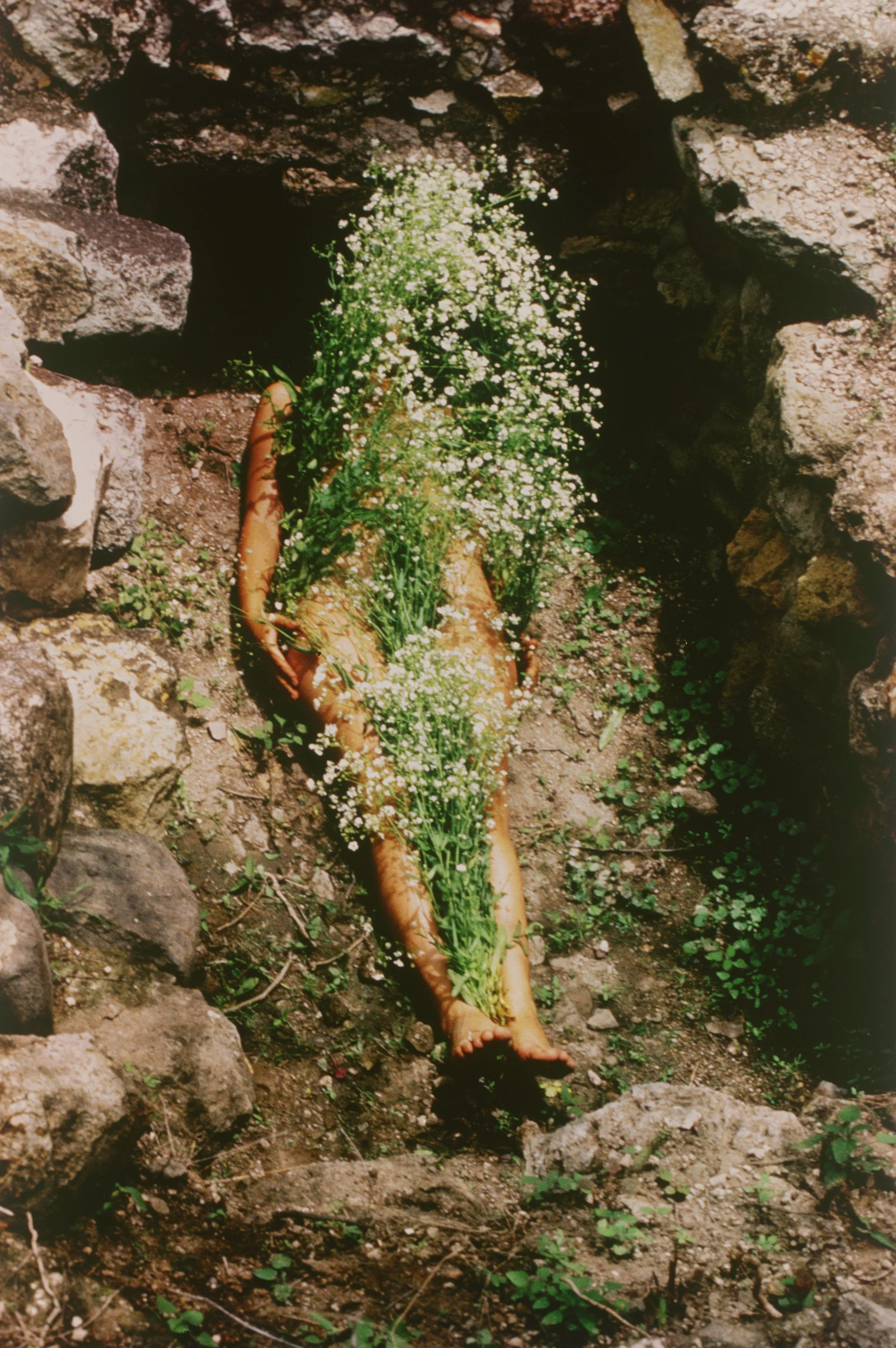
Ana Mendieta Imágen de Yágul 1973 Museum of Contemporary Art Chicago (Chicago, USA) ©The Estate of Ana Mendieta Collection, LLC. Licensed by Artist Rights Society (ARS), New York / DACS, 2026 / Courtesy Marian Goodman Gallery and Alison Jacques, London.
‘Like the flowers in her diaries, the film strip is here profoundly indexical. Abraded, deep furrows live on,‘fossilised by light on the film emulsion’. Filmmaker, carpenter, and sculptor sit side by side, each in their own way pulling time into space.’ Valentine Umansky
In conversation with curator Valentine Umansky.
The subtle blur within the films is evocative of the period from when they were made; they also seem as metaphors for works which are non-fixed to a category and yet co-exist as a consistent exploration. What do you feel the film works as a whole represents?
As written, beautifully, by our peer, poet and curator John Perreault, ‘Mendieta’s films comprise a brilliant body of work that, if looked at correctly, will also illuminate the photographs and the sculptures.’ (Covered in Time and History, p. 24). Though she had long created works (Siluetas and later carved-out sculptures) outdoors, her work typically reached viewers by way of films or photographs. Premiering in the UK, a series of newly remastered films made between 1971 and 1981 will illustrate Mendieta’s innovative approach to the medium, which initially included scratching or painting directly onto the celluloid. An outlier within her broader, representational filmic practice, the scratched and bruised pellicule shows traces of Mendieta’s hands, and I consider it a pre-flower herbarium, related to the pressings – an idea planted in my mind by scholars of early cinema processes. Just as the walls of the caves bear traces of the past and Mendieta’s notebooks trace encounters in the field, film, when treated as a surface to be engraved, becomes a convocation of time. Like the flowers in her diaries, the film strip is here profoundly indexical. Abraded, deep furrows live on, ‘fossilized by light on the film emulsion’. Filmmaker, carpenter, and sculptor sit side by side, each in their own way pulling time into space.
She also captured numerous bodies of work in film, enabling visitors to experience her iconic Silueta de Cohetes (Firework Piece) 1976 and Bird Run 1974, depicting the artist covered in feathers running across an empty beach. Fleeting, and constantly ‘alive’ the medium of film (which circulates, and is animated by light) is in constant flux and motion. As she suggested, ‘My art is grounded in the belief of one universal energy which runs through everything: from insect to man, from man to spectre, from spectre to plant from plant to galaxy. My works are the irrigation veins of this universal fluid. Through them ascend the ancestral sap, the original beliefs, the primordial accumulations, the unconscious thoughts that animate the world’. (Ana Mendieta, artist’s statement from 1983, Sulfur 22, published Spring 1988.)
There is a quality of silence within Mendieta's films that focuses the viewing experience within a very specific manner. Do you feel that the sense of silence is explored within other forms within the artist's practice?
Most of Mendieta’s filmworks were indeed silent. A turning point took place with Ochún, a film realised on 13 October 1981 at Key Biscayne in Florida. The video opens to an outdoor scene of sky, water, sand, and the piercing calling sounds made by a flock of seagulls. This film is also, as far as we know, her last. We often wondered whether she would have continued to work with sound, had she made a return to film later on in her life...
The artist's works vary in form, yet are closely linked within a singular identity. When working with the different media explored by the artists, how have you ensured a cohesive exhibition?
Mendieta liked to say that the works “exist on two levels”, “in nature and eventually eroding away” and “as documentation” (Interview between Joan Marter and Ana Mendieta, February 1, 1985), hinting at the dual nature of the practice: outside museum walls, or as documentation of an event, already passed. This means that for a same silueta, you’ll often have both a photographic view (or several) and a film (sometimes two or three). This plurality is part of her process, and we tried to foreground it in the exhibition, which is not organised by medium, but rather by themes, or in this instance, by metaphorical locations (eg. the ‘grove’, the ‘cave’, the ‘school’, the ‘sacred grounds’, etc.) The recurrence of symbols or ideas, across media, made our curatorial job easy!
Mendieta was quoted as saying: “The turning point in art was in 1972, when I realised that my paintings were not real enough for what I want the image to convey and by real, I mean, I wanted an image to have power, to be magic.” Which pieces do you feel are most concentrated with a sense of magic and why?
Offering a chance for visitors to engage directly with the living and impermanent aspects of Mendieta’s practice, several of her installations will be restaged for the exhibition. ‘Nañigo Burial 1976’, a Silueta made from black burning candles, will be lit regularly during the run of the show.
The cultural timing to present an exhibition of the work of Mendieta is fascinating. Why do you feel a show of this nature is arresting for now?
Many of the ideas Ana Mendieta put forward feel all the more critical today; particularly her persistent engagement with the natural world. Mendieta started her Silueta Series during a trip to Mexico in 1973, where she was inspired to make life-size ephemeral works exploring notions of existence, resurgence and renewal. She burnt, carved and moulded Siluetas into landscapes in regions across the Americas and Europe, often returning to sites meaningful to her or connected to ancient histories. As a generation impacted by environmental crisis, we have similarly grown more aware of our interconnection with the natural world, and I hope that the exhibition will help visitors reflect on their own positionality, and engagement, with what surrounds them, including with times that preceded us.
Ana Mendieta celebrated a liberated, powerful female body. This body takes part in nature, and merges with it. She also participated in feminist debates along with other artists to whom she is close, such as Nancy Spero, Howardena Pindell and Kazuko Miyamoto. She campaigned for greater consideration for racial minorities.
The influence of Mendieta is far-reaching - within the artist's works and also within the philosophies connecting body and earth. What do you feel her legacy as an artist is, and who do you feel has been directly informed by her perspective?
For all the reasons cited above, she has left a mark in the history of art, of feminist thought and praxis, and beyond. Artists refer to her constantly, including of course, the legendary Tania Bruguera but also Ana Teresa Fernández, Coco Fusco, Laura Aguilar or even Simone Leigh, whose work often explores the female body in relation to materials, echoing Mendieta's themes of identity, ritual, and bodily connection to the earth.
As a curatorial team, have there been moments of discovery within the curation of this exhibition that you did not expect?
Many! One of them – which will continue to unfold – is the discovery of our new movable wall system. This is a project that will outlast the Ana Mendieta exhibition itself, and will allow our exhibition's carbon footprint to reduce, allowing curators to reuse walls, rather than build and destroy. This gives us a set of parameters to experiment with, as we had to reinvent the space accordingly, to reimagine the floors (and floor plan) with this new set of walls. It’s a wonderful puzzle – and one I hope we solved successfully! The visitors will tell.
Ana Mendieta, Tate Modern. 15 July 2026 - 17 January 2027.
With Special thanks to Valentine Umansky, Susannah Haslam and Perry Steward.