
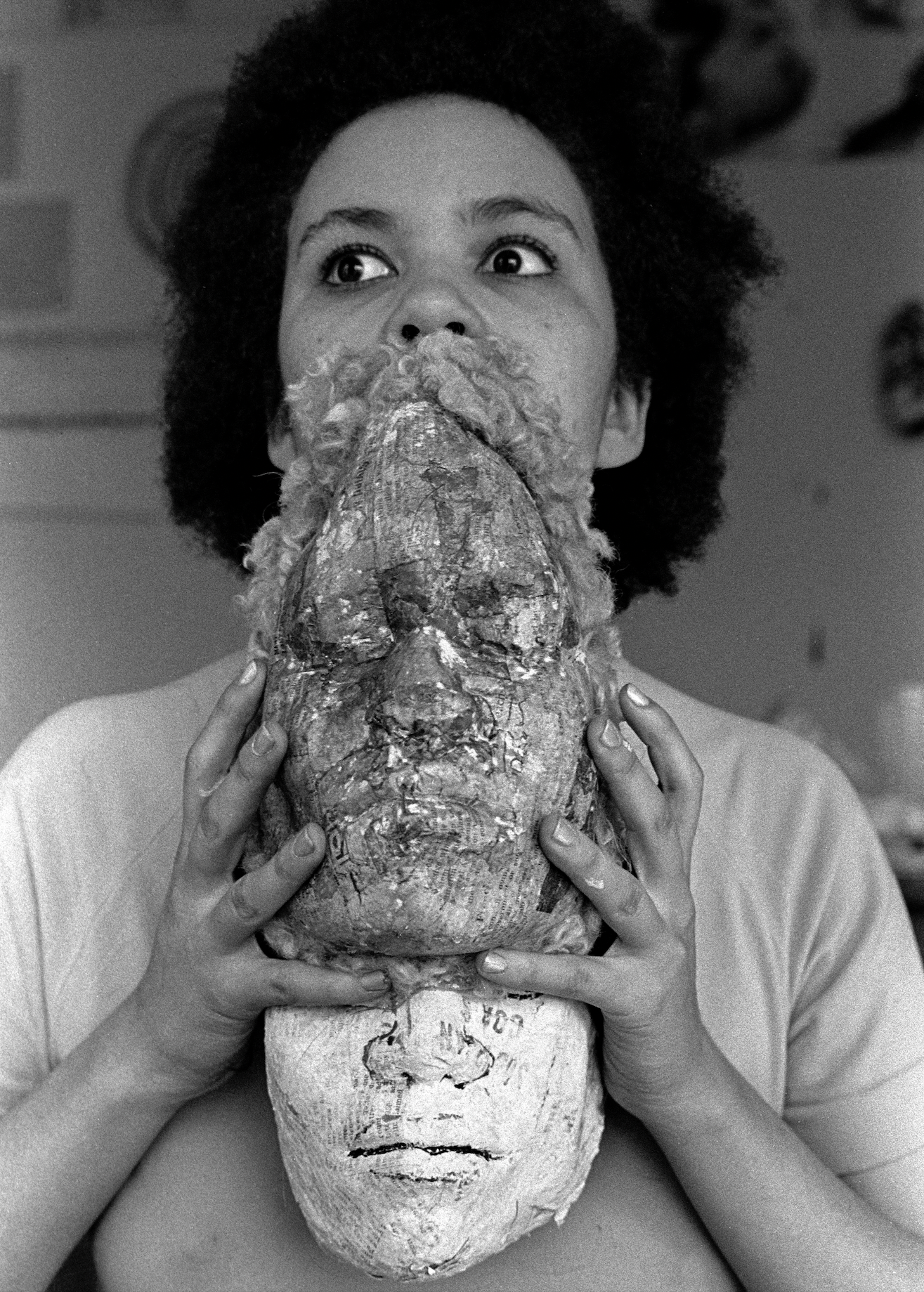
Marisa Gonzalez, Lizz Williams y sus máscaras 1974-5. Image courtesy of the artist. © Marisa Gonzalez.
‘…My quest involves subverting technological means and the standard messages they usually convey, putting them at the service of those silenced voices.’ M.G.
Over fifty years have passed since Marisa Gonzalez made a series of portraits of her classmate Lizz Williams, while a student on a study trip to Washington D.C. from her hometown in Spain. The series was re-presented in Paris in 2025 - a time capsule as iterations of thoughts - caught and pressed into office supply copy and acetate sheets - their surfaces dimpled with provenance, their focus - searing with purpose.
Please can you introduce the body of work presented at Paris Photo.
La Descarga, 1974-1975
Después de leer una noticia en un periódico de Washington sobre la violencia y la represión contra las mujeres en las cárceles chilenas, inicié un proyecto en el que colaboraron compañeras y profesoras de la Corcoran School of Art, a quienes propuse escenificar el impacto de la violencia sobre sus cuerpos, creando así una serie fotográfica de base performativa, práctica habitual en los grupos de concienciación feminista bajo el lema “lo personal es político”. Entre las participantes se encontraba mi profesora, la artista Mary Beth Edelson, y mi compañera de estudios Karen Sommerville. Con Karen, en la Corcoran Gallery realicé mi primer vídeo performance titulado Violencia, donde quise reflejar la represión y tortura política mediante secuencias de “action painting” en una pared de la sala.
Posteriormente, trabajé sobre estas sesiones fotográficas montándolas en acetatos de alto contraste procesados con la máquina Thermofax, y fui creando series modulares, que se mostraron en el Corcoran DuPont Center de Washington D.C en 1975, y también en New York en Cayman Gallery 1977, y en el 78, en el Museo de Arte contemporáneo de Madrid MEAC, entre otros.
The Download, 1974-1975
After reading a news article in a Washington newspaper about the violence and repression against women in Chilean prisons, I began a project in which colleagues and professors from the Corcoran School of Art collaborated. I proposed that they stage the impact of violence on their bodies, thus creating a performative photographic series, a common practice in feminist consciousness - raising groups under the motto "the personal is political." Among the participants were my professor, the artist Mary Beth Edelson, and my classmate Karen Sommerville. With Karen at the Corcoran Gallery, I created my first video performance titled: ‘Violence’, where I wanted to reflect political repression and torture through sequences of "action painting", presented on a gallery wall.
Subsequently, I worked on these photographic sessions by mounting them on high-contrast acetates processed with a Thermofax machine, and I created a modular series, which were shown at the Corcoran DuPont Center in Washington D.C. in 1975, and also in New York at the Cayman Gallery in 1977, and in 1978, at the Museum of Contemporary Art of Madrid MEAC, among others.
There is a sense that the work seen in Paris is somehow not set… somehow unresolved, as if still hot from being processed, and yet because of the consistency of what was shown, the works felt to be interconnected, as a cohesion of elements. Please can you discuss the sense of how you work and how you know when a work is realised.
La interconexión y cohesión entre elementos que percibes en mi obra se da, en este caso, pienso yo, por el tema que me preocupaba en ese momento y por mi intención de aportar obras que causaran un impacto en los espectadores, que los moviera a tomar conciencia de esa realidad y de tantas otras similares que siguen aconteciendo en el mundo a lo largo de los tiempos, lamentablemente.
¿Cómo sé cuándo está lista una obra? Pues, cada caso es diferente. Son cuestiones estéticas y de contenido, ese equilibrio, el que me lleva a decidir que una obra se puede mostrar como “terminada”, en un sentido. Pero nunca, en mi caso, eso implica un final, porque mis obras son generativas. Es un proceso que siempre sigue. Siempre sé cómo empieza, pero durante el desarrollo del proceso surgen nuevas vías a seguir. Sé cómo voy a empezar, pero nunca puedo prever cómo va a terminar.
The interconnection and cohesion between elements that you perceive in my work, in this case, I think, stems from the theme that concerned me at the time and my intention to create works that would have an impact on viewers, moving them to become aware of that reality and so many other similar ones that, unfortunately, continue to occur throughout the world.
How do I know when a work is finished? Well, each case is different. It's a matter of aesthetics and content, that balance, that leads me to decide that a work can be shown as "finished," in a sense. But in my case, that never implies an end, because my works are generative. It's a process that always continues. I always know how it begins, but during the development of the process, new paths emerge. I know how I'm going to start, but I can never foresee how it will end.
The sense of subversion feels very pronounced within your work, the use of media - sense of the ancient, the primal and also a certain feeling of privacy which feels violent. Please can you expand on the sense of instinct and subversion within your work.
Qué hermosa y sensible lectura de estas obras. Pienso que se debe a que yo he querido expresar emociones íntimas pero universales, emociones que no se limitan al hecho en sí que me movió en cada caso particular, sino a cuestiones con las que nos hemos tenido que enfrentar a través de los tiempos y que, por más que haya avances tecnológicos importantes, siguen sucediendo. Mi búsqueda tiene que ver con subvertir esos medios tecnológicos y los mensajes estándar que suelen comunicar para ponerlos al servicio de esas voces silenciadas.
What a beautiful and sensitive reading of these works. I think because I wanted to express intimate yet universal emotions. Emotions that aren't limited to the specific event that moved me in each particular case, but rather to issues we've had to confront throughout history and that, despite significant technological advances, continue to arise. My quest involves subverting these technological means and the standard messages they usually convey, putting them at the service of those silenced voices.
I am fascinated by your approach to making the work - the use of different machines, such as photocopies, which could seem impersonal, and yet your approach is very emotive…
Justamente en eso está la subversión, en utilizar la máquina para transmitir mensajes más humanos. Las máquinas son las herramientas que nos permiten crear a partir de un lenguaje contemporáneo. Me acerco a ellas con la intención de explorar su potencial creativo. Cada una deja una impronta diferente en las obras y esa peculiaridad que las diferencia, o que incluso constituye muchas veces sus propios límites, es lo que me interesa explorar y desarrollar. Hay que ir conociendo bien cada máquina para saber lo que te puede ofrecer y no pedirle aquello que no te puede dar.
That's precisely where the subversion lies: in using the machine to transmit more human messages. Machines are the tools that allow us to create using a contemporary language. I approach them with the intention of exploring their creative potential. Each one leaves a different imprint on the works, and that peculiarity that differentiates them, or that often even constitutes their own limitations, is what interests me. You have to get to know each machine well to understand what it can offer and not ask it for what it cannot give.
The presentation of works made in the 1970s, seen at Paris Photo were fascinating. I am very interested by the sense of an active archive, where works are still in use, revisited with an evolved sense of context, please can you discuss what the archive means to you and how you use it.
Para mí el archivo es algo que está en potencia, algo orgánico. A veces, lo revisito con una intención específica; otras, porque algo olvidado reaparece y me abre nuevas vías, porque al redescubrirlo constato su potencial vigencia.
For me, the archive is something that exists in potential, something organic. Sometimes, I revisit it with a specific intention; other times, because something forgotten reappears and opens new avenues for me, because in rediscovering it, I confirm its potential relevance.