
133. OISHI ROY DUTTA: A SPACE BETWEEN INTERSECTION AND INTERROGATION.
Oishi Roy Dutta, “ROW”, Tate Britain - LONDON.
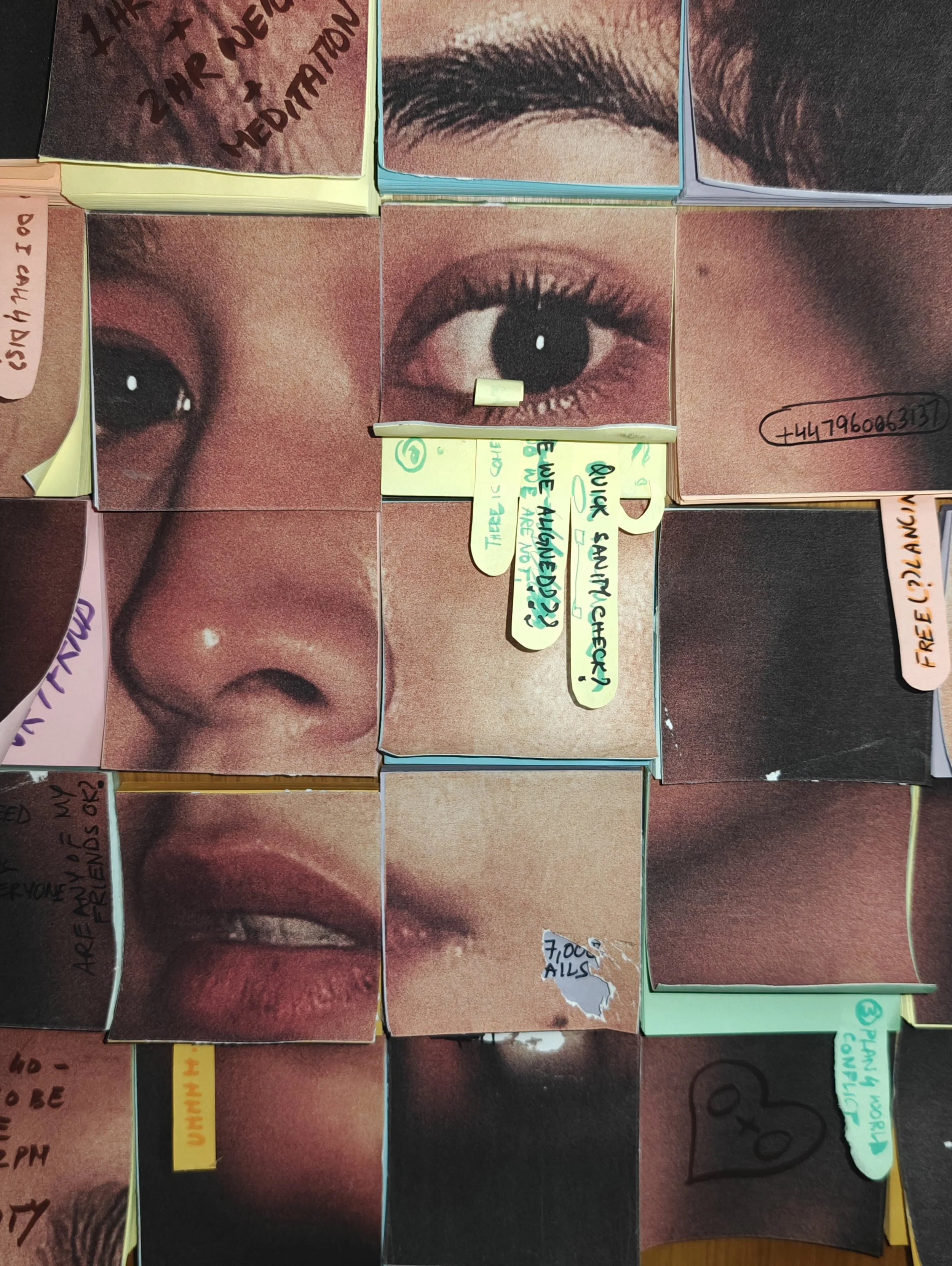
Oishi Roy Dutta, “Sanity Check”, 2026, Mixed Media. Image courtesy of the artist.
‘I’m in a post-dream phase of my life. Where I can't just be an idealistic dreamer, it's time I bring all this ambition and experience into action. As a result I am pulled in a million directions, all recorded on post it notes…’ O.R.D.
Collage and weaving are techniques which you return to within your practice, what do these methods mean for you?
It is all essentially a method I use to represent our multidimensional, interwoven lives. There are versions of us, physical, digital, public and private that kind of layer and weave through the fabric of our lives. Collage and weaving a very literal representation of that. It also allows me to expose the seams of our organic limits being pushed, expanded and even torn by the digital. The effort and time that the process takes becomes a part of each piece, as all the objects cut and stuck feel like a version of ownership, satiating at least a part of my desire to consume. It allows me to create moments of intersection and interrogation that I often respond to with humour.
You recently presented a series of works which were projected into a specific space, please can you introduce this work?
Yes, the work being talked about is my short film titled “ROW” which was recently screened at the Tate Britain alongside the Lee Miller curation. The work discusses the loss of identity and selfhood under a fervent collective. Anchored by the presence of red fabric, an emblem of power, sacrifice, rage, and divine authority, the film follows the relationship of a group as they are slowly consumed by the ecstatic force of communal ritual. What begins as devotion unravels into disorientation, as the overwhelming unity of the group erodes not only personal identity but the very foundations of moral judgment. It was important that religion wasn’t the only institution that is referred to but also, political and other groups that carry social currency, and have the ability to sway people with propaganda.
Please can you expand upon why you use certain colours within your practice?
I think I have always been a little fascinated with red. More so over the last year. Silver is the close second contender in its share of obsession. It is just such an alluring colour. It represents the unavoidable to me. It represents the need for consumption, love, hate, danger, rage. It is a representation of intensity. It's seen in the body and being, when you close your eyes. It is simply a representation of a version of me that I cannot ignore and should not be. As more often than not, it signified importance and a need to divert attention.
Symbolism of object and organic matter reappears within your practice, such as tomatoes - please can you expand upon why you choose these items?
It's very simple. I really love tomatoes. I love to eat them, they look cool, and they are good for you. It's my way of bringing in some ridicule and humour to my work that represents the very ridiculous things we focus on and the absurdity of modern lives.
The memo pad portrait is fascinating and appears to combine photography and performance - please can you expand upon this work?
The work is titled “Sanity check” a title that came up from my absolute repulsion to the phrase, when someone brought it up during a work meeting. Sanity, reduced to a quick and simple “check” seemed very descriptive of our time. I’m in a post-dream phase of my life. Where I can't just be an idealistic dreamer, it's time I bring all this ambition and experience into action. As a result I am pulled in a million directions, all recorded on post it notes, these ridiculous lists of 10 - day long tasks “to-dos” to be somehow managed in one day. It takes an incredible mental load to keep going, often checking off a task takes away little parts of me, eroding the surface bit by bit. Sanity check is the cost of a dream, where identity is commodified and each action needs to have a monetary profit.