
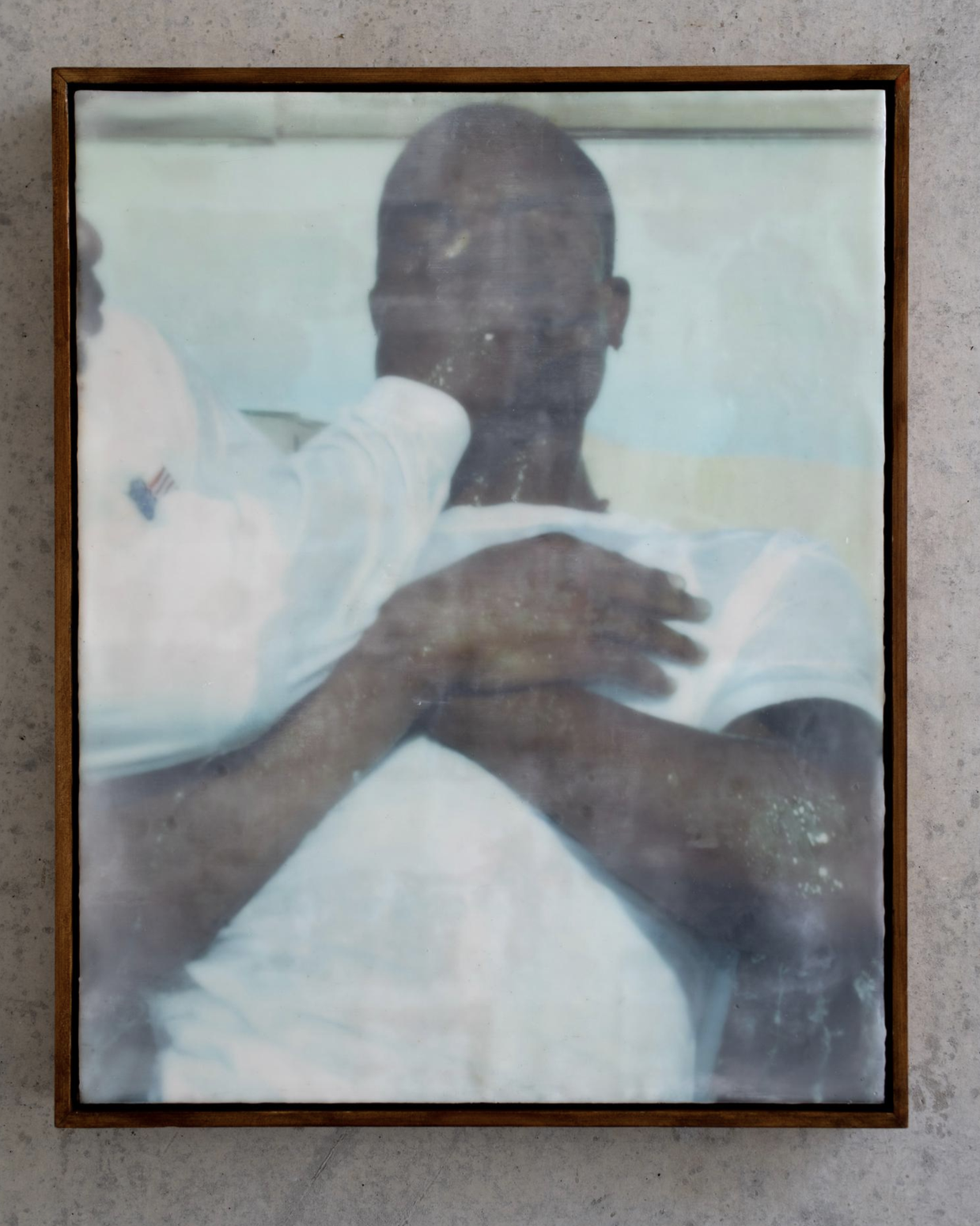
Trinity Ellis, Archival print, wax & oil paint, mounted on hardwood plywood with artist-made frame, 2026.
‘What holds me to account is the men in the photographs. They never agreed to be looked at like this, and they can't answer back. So my job is to find what was already there, not put something in.’ Trinity Ellis
Please introduce ‘Permitted Contact’.
Permitted Contact uses photographs from the US military archives at NARA, images made to record a procedure rather than to be looked at. What drew me in was the contact: men gripping, wrestling, restraining, baptising one another. Even baptism involves holding a man under water. Every instance is sanctioned by an institution. The work asks how men are taught to touch each other, and how often that comes through violence.
I felt, when seeing the works in person, that there was a sense of a certain benign violence: how the works demanded your attention but also appeared as an installation, and so there was a knowing sense of confusion, like seeing TV screens playing multiple channels in a shop window... This felt somehow to speak to the very current issue of being simultaneously overwhelmed and sort of held in that state until the energy fails. What holds you to account within your practice?
Benign violence feels right. That’s what’s in the images: men being forceful with each other in ways that are allowed, even encouraged.
(When I presented the works) I hung a lot of works in a small space, with more stacked inside a military locker. It was a nod to the size of the archive, and to how many bodies the military gathers up and teaches to touch through violence. The overload is the point.
What holds me to account is the men in the photographs. They never agreed to be looked at like this, and they can't answer back. So my job is to find what was already there, not put something in.
The impression of the blurred image is captivating, a feeling of being between frames. Will you contemplate what ‘blur’ means for you in your practice?
The work comes from spending real physical time with these images: layering, pressing down, marking, scraping back, melting and reworking, often over weeks. It's slow, almost laborious, and the softness you see is the record of that time. What comes out of it is distance, or rather an image you have to lean into, and even then you're not quite sure what you're seeing. That suits the subject. The institution named what it saw; it's there in the title. I'm looking past that name, at something the archive was never meant to show.
This point of leaning in - to physically be drawn to something or someone with an aim to understand something which is sensed over being convinced - reads as an oblique signal. What do you feel your work signifies?
I like “oblique signal,” because that’s how closeness between men tends to work. It’s rarely stated. The work operates the same way. I want to hold that uncertainty long enough for someone to notice it. If it signifies anything, it’s that those signals were always there, even in an archive built to file them as something else.
I was interested to learn that you apply wax to the surface of the works, which further informs a sense of focus, a surface which responds to temperature - and I imagine enables the works to become ephemeral in a sense - please will you discuss your material choices within your practice?
The works can look fragile, but they aren't. The wax, pigment and resin hold these photographs in something that looks soft, almost like skin, but is durable, suspending them rather than letting them fade. I like that, because the men in these images were trained to be hard, to hold themselves against one another even in moments of contact. The archive kept them as paperwork, as evidence of how men are supposed to be. In the wax they're allowed to be softer, and they last just as long.
When I saw your works, I was a little thrown, where these paintings or photographs - the sense impressions - immediately position the work within a specific context in art history, and yet there is also a certain resistance to being framed within a position - please will you discuss the sense of context and your relationship with materialising this?
Painters have long worked from photographs, usually as a reference, something to use and then leave behind. Here the photograph doesn't go anywhere. It's physically in the work, under the wax, and the painting has to deal with it rather than replace it. The painting stops the photograph being just a document, and the photograph keeps the painting tied to something real. Neither fully takes over. In a way, that relationship is the work: my hand on the institution's record. People are often intrigued by how the works were made and want to categorise them so they can understand them, and I like that. It's close to what the series is about, what becomes permitted once something is named. I'm not concerned with settling it. The references are there, but fixing a position closes the work down.
Then there's the question of authorship. These aren't my photographs. They were made by an institution, for its own purposes, by people I'll never know. I've reworked them and changed what they're for, so does re-understanding them stake a claim? Does it even matter? I don't think it settles ownership. It adds a second author over the first, and the image carries both.
The mixture of media further supports a feeling of shape-shifting - of crossing boundaries and redistributing focus within the experience of witnessing the work... How the experience differs in an image from experiencing in life... Was that your intention? And if so, what has the work taught you?
The works don't reproduce. In a photograph, the surface, scale and depth of the wax flatten out. These images were made to circulate as information; as paintings, they take up space in the room with you. Standing in front of them puts your body in proximity to the bodies in them, which is its own kind of permitted contact. That wasn't the plan; it followed from the material. What the work taught me is that an image stops being a document once it's been handled enough. It stops being evidence and becomes a body. That points to the larger question: if men only learn to touch each other through drill, combat or ritual, then tenderness has to borrow a uniform. These images show how much closeness exists inside those structures, and how rarely it's allowed to be called what it is.