
145. FRIDA KAHLO: A SPACE BETWEEN HEARING AND SEEING.
Frida: The Making of An Icon, Tate Modern - London.
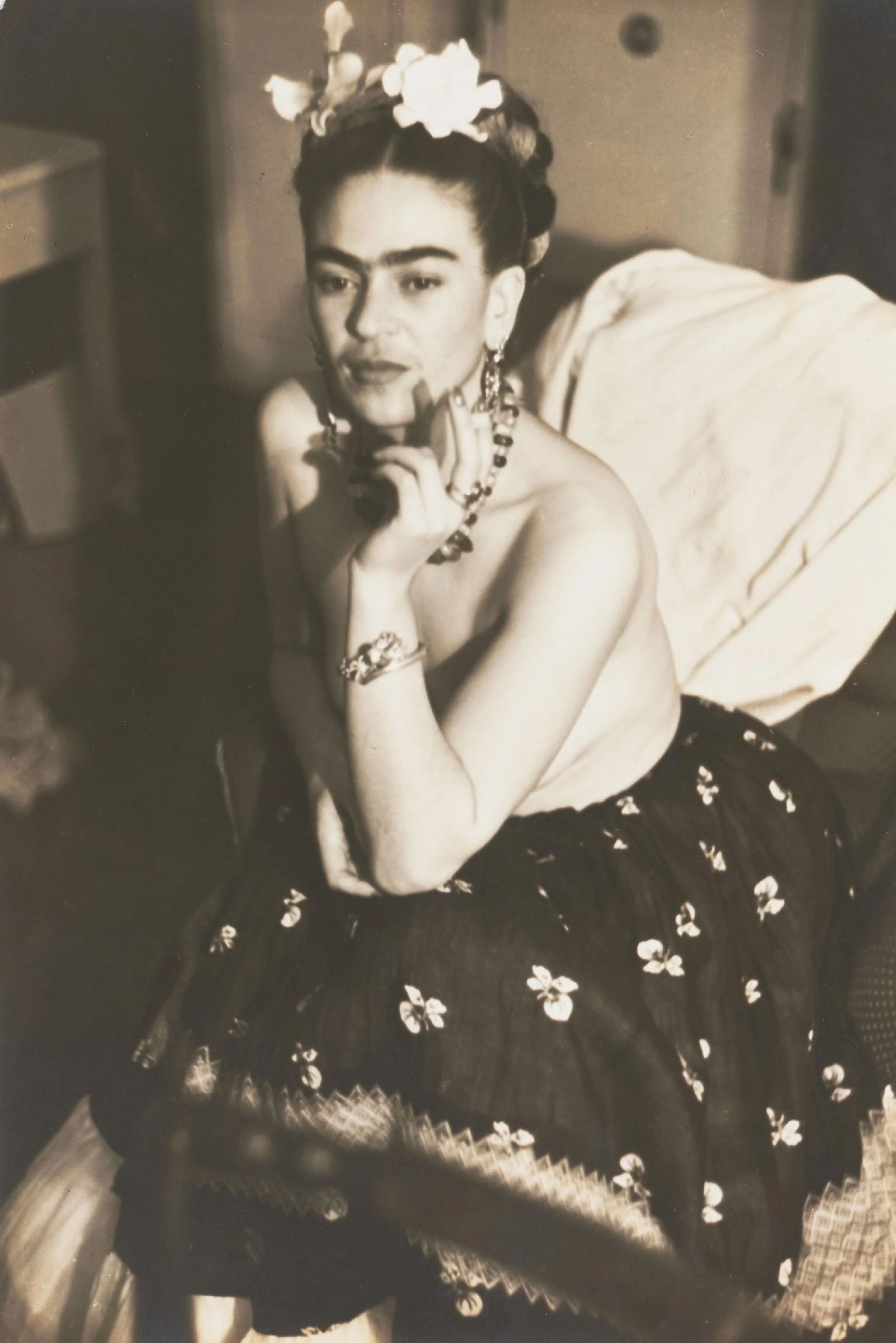
Frida Kahlo photographed by Julien Levy, 1938. © Courtesy Philadelphia Museum of Art.
…The calm host of photography underscores this presentation, allowing for the patience of clarity that Kahlo's consistent eyeline demands.
A continuum of black-and-white - depicting the artist and her shape-shifting silhouettes captured through multiple personas - thrilling and contradictory. M-A.
Which direction to contemplate Frida: The Making of an Icon? Kahlo's fixed stare locks my gaze from the first portrait, a photograph taken by the artist's father, fringed with palms and darkly shadowed within the protective walls of the Kahlo Hacienda. Exemplary of the atmospheric return to calm consistently sensed within the artist's work. Should I focus on the metaphorical appreciation of nature and the influence of the personification of Mexico—seen within landscapes, patination, and the costume of dress, bold and rhythmic in contradiction? Will the focus rest on community and personal culture? How the artist was informed and influenced by human contact within her life, despite predominantly being depicted alone. Should I follow the curatorial lead in terms of how the iconography of a person was formed and forged?
As I walk from room to room, magenta to teal, there is an ongoing tug, akin to the loyal reminder of one of Kahlo's pet dogs, pulling at her lace hem — to return, to return to instinct, which surely is at the heart of Kahlo's work as a whole and legacy.
Intriguingly, I feel that this exhibition played the role of the underdog from the outset; news leaked last year that large-scale paintings were proving challenging to obtain for the upcoming summer show. This seemed an obstacle that I assumed the Tate would overcome, providing a tantalising brief to sustain an exhibition to justify its title. This aim initially felt like an exciting curatorial prospect; however, the exclusion of such monuments to Kahlo's mythology is felt, resulting in a show that is reliant on a multitude of smaller works for substance and, in essence, attempts to fill this void. A further opportunity was missed due to the patchy rhythmic approach to scenography and cohesion of elements, which rely on the assortment of small works often dwarfed by the enormous rooms, where an inevitable echo chamber is created by voices other than Kahlo’s. The inclusion of such visionaries as Carrie Mae Weems and Ana Mendieta is well-meaning and yet somehow confusing within this exhibition.
There are jewels within this selection, however, namely 'Untitled (Self-Portrait with Thorn Necklace and Hummingbird), (1940), and 'Tunas (Still Life with Prickly Pear Fruit)' (1938), which help to tether the signifying power of Kahlo's intimacy with scale and composition. The pre-mentioned still life is richly contradictory and delights in the artist's taste for the perverse, as spliced bodily organs, bleeding as if to be extracted - held and awaiting on a domestic plate - as waves of cloth lap boyantly beneath, suggestive of a journeying raft of survival.
Thankfully, The calm host of photography underscores this presentation, allowing for the patience of clarity that Kahlo's consistent eyeline demands.
A continuum of black-and-white - depicting the artist and her shape-shifting silhouettes captured through multiple personas - thrilling and contradictory.
Exploring identities rooted in fantasy, realism and ethnicity, as container and contained - A sense of minimalism in exposing facets of self that are most arresting - devoid of decoration and stripped back to a self-exposed, dignified and raw as a sampling - rooted in heritage - primal in resistance to being tamed — It is here that Frida's iconic status burns brightest.'
When viewed today, these photographic depictions could be seen as subtle, even whimsical, and yet at the time of print, they were radical, and it is here that the real focus of the exhibition is held, even saved. To be your own muse, your own inspiration, both conceptually and physically. How an identity is constructed and how the framing and fashioning of a manipulated self is proposed. Captured by a series of intimate acquaintances whose portraits of the artist create a fascinating sense of collective consistency: Proposing a singular aesthetic — suggestive that Kahlo's decisive voice within the image controlled how she chose to be seen — is further suggestive of her ability to capture and package her own view - and her own brand I.P.
The exhibition as a whole, in comparison to current shows at Bourse de Commerceand Vuitton's Foundation in Paris, manages to capture the very spirit of discovery within collections presented—namely, Alexander Calder's monumental retrospective, where the museum's approach to scenography manages the weight of an archive with the lightness of a conductor's baton. Inviting generational awe without the repression of visual tone, which the Tate too often falls prey to. With every good intention, I wonder if, by trying to impress, the aim to present key works with improved clarity and space would allow the viewer to contemplate rather than to be entertained. And it is this that the aforementioned galleries understand.
There is 'something for everyone' within Frida: The Making of an Icon, and yet I long to witness the exhibition of 'everything of someone' and that being Frida themselves.
Ironically, the exhibition loops back on a hope that the viewer would learn anything other than what the gift shop's plethora of merchandise has to offer —and there is genuine sadness and artistic compromise within that thought. Kahlo's pedestaled position sustains financial streams of projection but not of the continuous states in which she was most revolutionary and brave in proposing.
Frida: The Making of An Icon, Tate Modern London. Until: 3 January 2027.
With thanks to Perry Stewart and Ekua McMorris.