
143. ALEXANDER CALDER: A SPACE BETWEEN EMOTION AND MOTION.
CALDER. Rêver en équilibre, Fondation Louis Vuitton - PARIS.
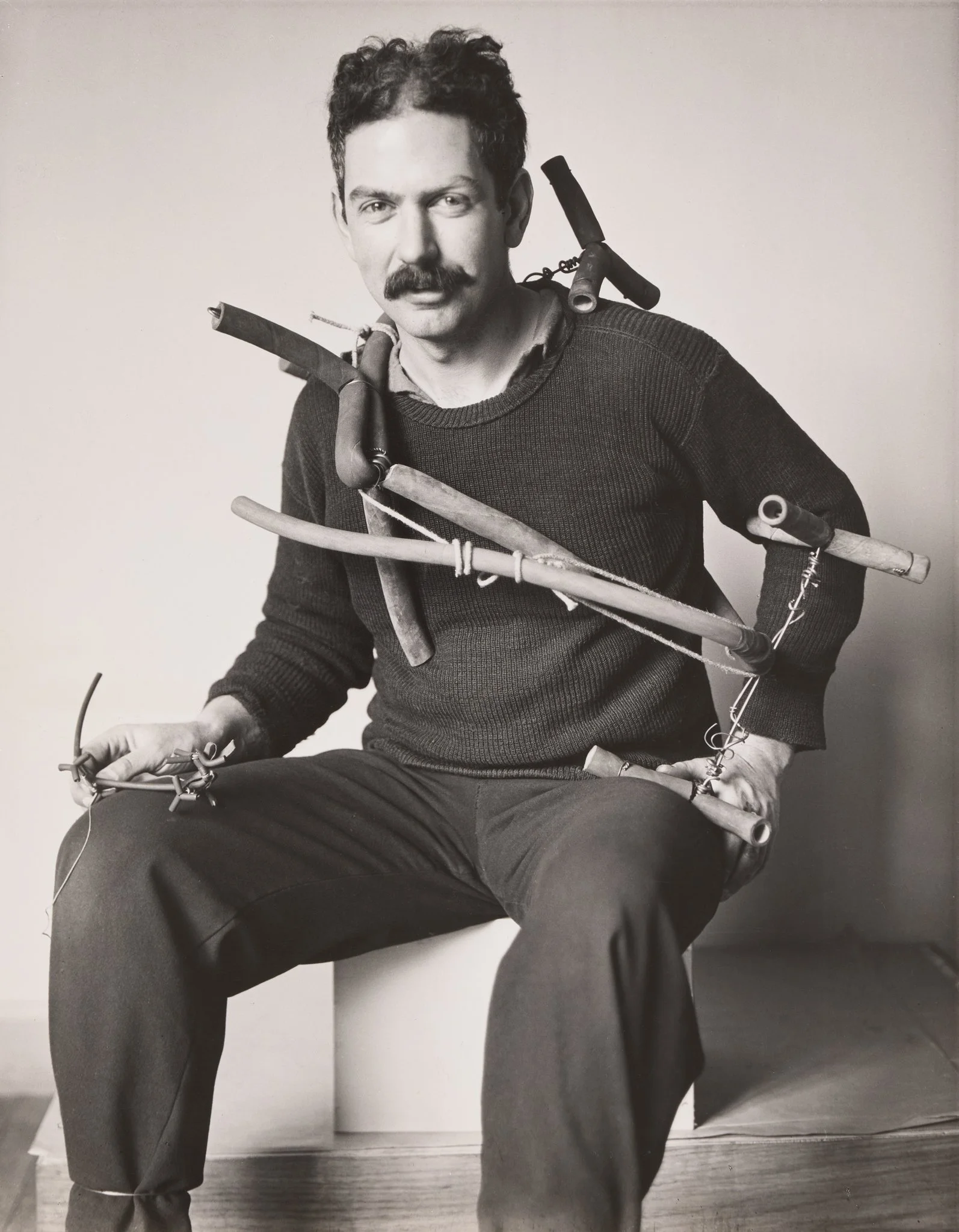
Alexander Calder avec Miss Tamara, Paris, 1929, by André Kertész. Source: Online.
Waves of wonder ripple Paris with an energy which radiates from the Frank Gehry created gallion of a foundation, anchored within a forest. Its sail-like structure billows with the force of nature, which is contained within its four floors. For Foundation Louis Vuitton, an empire built upon the values of travel, this sense of discovery is far-reaching - both within intention and creation: a retrospective of some 300 parts, by the American master of movement, Alexander Calder, an exhibition meticulously pieced together to form an overview of a new world order. Not a man's world - a child's.
The eyes of Calder, smile down upon each visitor on arrival within André Kertész's 1929 portrait of the artist as a young man - his body swaythed with the materials of his calling; pipes, rope and wire frame his torso - as to be festooned with reimagined victory laurals, the image also suggests breaking free from a shackle of prevention - either as symbol of future fame or as act of resistance, maybe both or neither and that is a quality of Calders' position and ambiguity of motive behind the meaning of a body of work which continues to fascinate and challenge.
The forming of a language is well evidenced - the dialogue of movement articulated through the physicality of metal to form the undulations of a continuum. Galleries testify to predate the arrival of Calder's breakthrough mobile forms - including early maquettes of circus scenes fashioned using the pliers believed to be a childhood Christmas gift in 1906. For his language of line, first uttered as a child and then refined in Paris as a young man, captures the awe of witnessing Josephine Baker's rhythmic movements, distilled within a single line - presented as a shaddowed twin - reverberating as a record on the gallery wall. His tremulous depictions of movement - solidified in permanence, archive space, and when viewed today, as at the time of making - resolutely communicate the emotion of motion without the stoicism of academia. For the scientist and mathematician in Calder knew that his way forward was to continue a loyalty to line via connection to the cosmos. Early undulations of movable parts made during his Paris revolutionary years softly orbit, seen on show as evocations of solar systems, directly informed by Albert Einstein’s theories of relativity, a published work that the artist was to reimagine in his own language of metal movements.
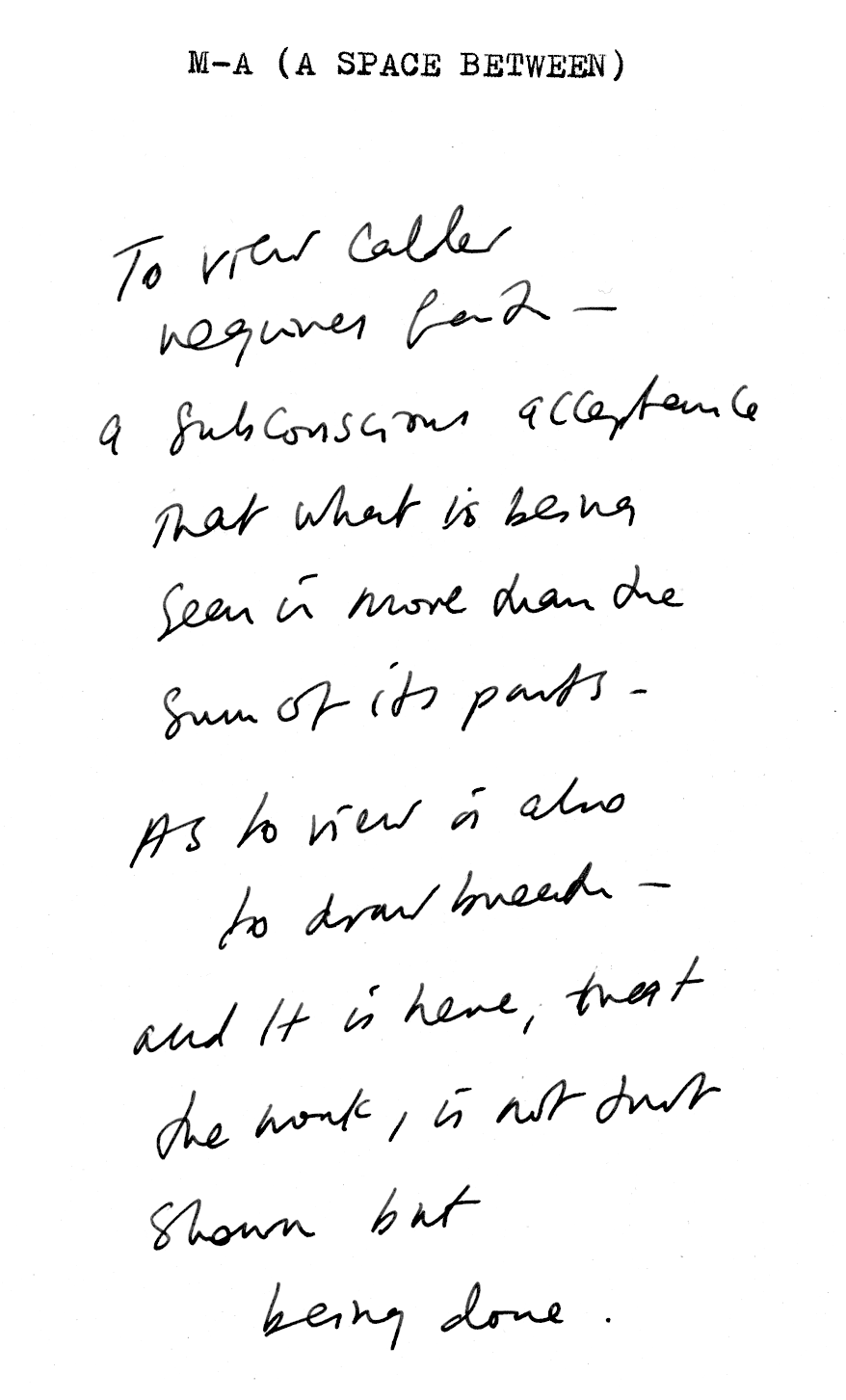
To view Calder requires faith - a subconscious acceptance that what is being seen is more than the sum of its parts. As to view is also to draw breath - and it is here that the work, is not just being shown, but being done.
Splaying from a spine, evoking the immediacy of nature, as leaf, mamel or the rippled surface of a pool - all are connected within Calder's all-sensing state of impulse. An inversion of a world - as to look into a murcurial mirror of calm - where an alternative life stretches to arc - from mechanised as rigid to undulate a smile. The viewer knows that they are looking at industrial materials, re-fashioned by one pair of hands - and yet - the work evokes such deep understanding of the organic as to become another sort of nature - it is as if, the work stimulates an ancient, ancestral memory which pauses time and aligns our humility to focus.
The notion of levitation within the works are central to the artist's specificity of atmosphere, as a consistent rhythm which is sensed as a calm heartbeat throughout the exhibition as a whole. Isaac Newton's law of action and reaction distils: For every action, there is an equal and opposite reaction - and so, through the work, the viewer too embodies this state of calm equilibrium.
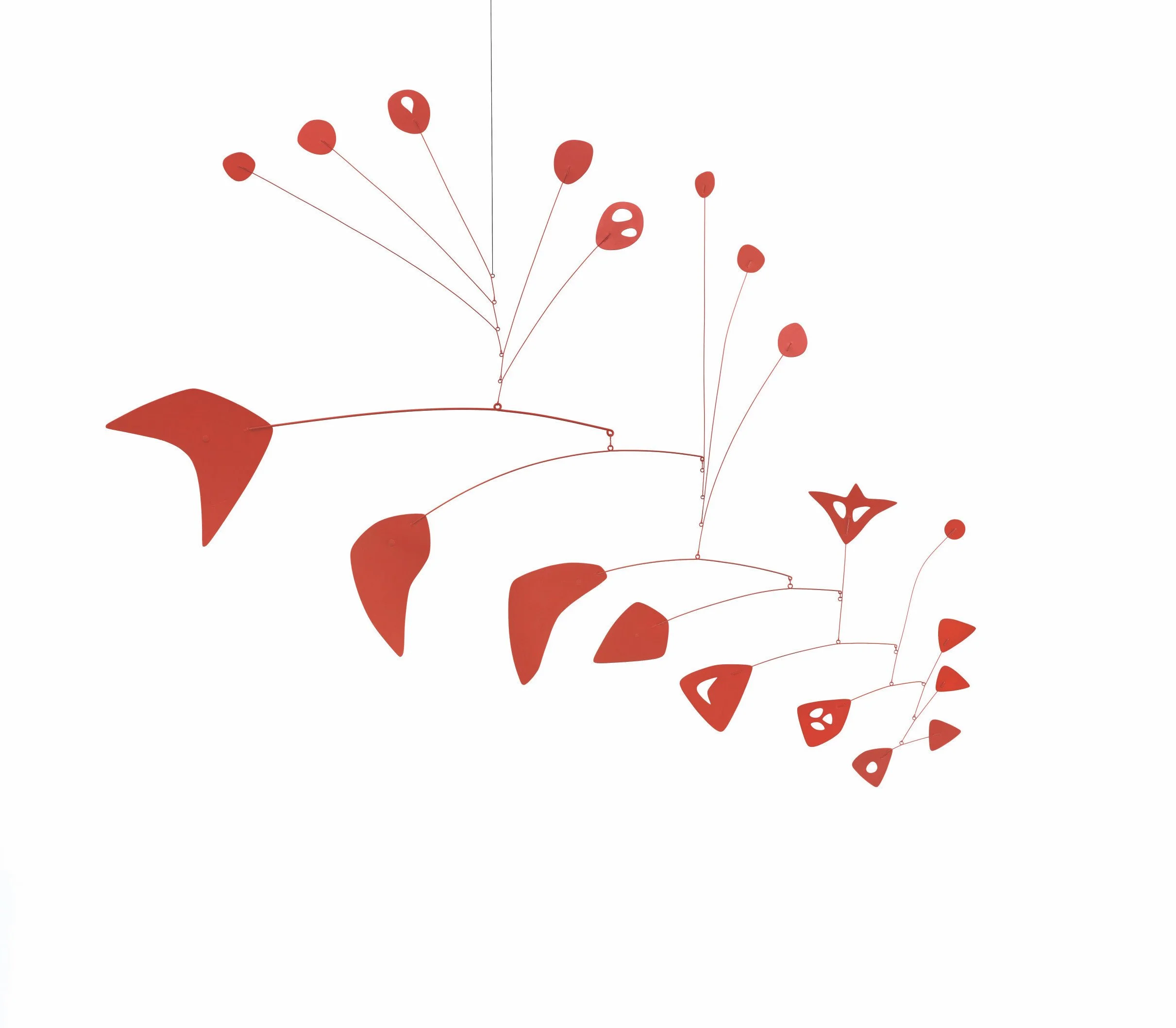
Alexander Calder, Red Maze III, 1954, Feuille de métal, fil de fer et peinture, 142,2 x 182,9 cm, Calder Foundation, New York © 2026 Calder Foundation, New York / ADAGP, Paris. Photo courtesy of Calder Foundation, New York / Art Resource, New York.
CALDER. Rêver en équilibre, Fondation Louis Vuitton Paris. Until 16 August 2026.
With thanks to Pierre-Edouard Moutin.