
AMOCA Dialogues - Cardiff.
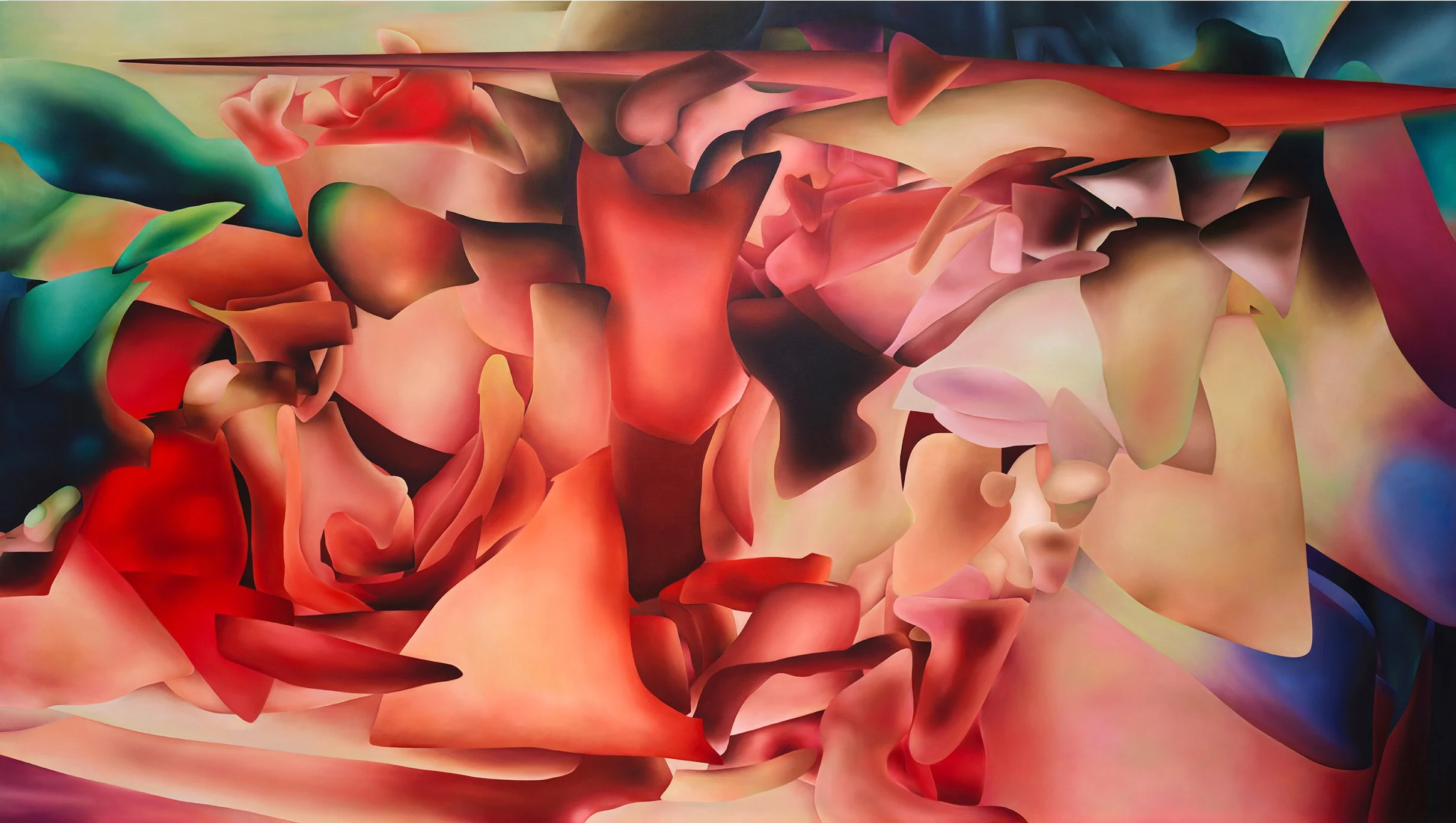
Angela Santana, Speaking in Tongues, 2024, Oil on canvas. 65 1/2 × 116 in. Image courtesy of the artist.
‘For me,(my work) represents a site of resistance. My subjects are unapologetic and exist entirely on their own terms, challenging the status quo. A continuum, a dialogue with the past and the future… It’s about holding opposing forces in the same frame until they vibrate, ensuring the viewer never feels quite settled, but remains completely captivated.’ A.S.
The sense of fracturing, of a multi-faceted perspective, really is intriguing when viewing your work. Please can you contemplate the sense of perspective within your practice?
At the heart of it lies a desire not to record reality, but to reimagine it. While Brunelleschi’s Renaissance system of linear perspective offers a satisfying mathematical accuracy, it is too fixed for the world I am envisioning. I had to develop my own system — a multi-faceted perspective that allows for the 'in-between.' It creates a space where movement, the coming together, and the falling apart can all exist at once.
I immediately think of Tamara de Lempicka when I see your work, this sense of shifting - pivoting between movements, between times, which artists have inspired and informed your point of view?
A sense of shifting is a good way to describe it. For me, that movement stems from an absolute urge to express something that I haven’t seen around me, but knew needed to come to the surface.
I find myself most drawn to works that bridge the gap between immediate impression and psychological depth. Louise Bourgeois for her raw, emotional architecture and sensuality, for example, Eadweard Muybridge for his obsession with the mechanics of motion and the breakdown of time, and David Lynch for his ability to make the subconscious feel physically present. They all share a fascination with what lies beneath the surface, which is exactly where my process begins.
What do you feel your work as a whole represents?
To me, (the work) represents a site of resistance. My subjects are unapologetic and exist entirely on their own terms, challenging the status quo. A continuum, a dialogue with the past and the future.
There is a complex polarising quality within your work, of a sensual feeling of caress and also a splintering which feels hard-edged. Please can you explore the sense of synaesthesia within your work?
I am always striving for that elusive equilibrium — a state of friction where the familiar and the unsettling collide. I aim for a quality I call 'Umami': a complex, rich experience with layers that refuse to reveal themselves all at once, unfolding only over time. It is something incredibly alluring, yet indescribably strange.
I want the work to live in that high-stakes friction. It’s about holding opposing forces in the same frame until they vibrate, ensuring the viewer never feels quite settled, but remains completely captivated.
By presenting the mundane with the same monumental weight as the grand, I embed an absurdity that refuses to apologise. This irreverence creates a restless energy, a mix of joy and subversion that forces an active, perhaps even uncomfortable, reconsideration of the world around us.
The fetishised body is a topic which is rooted in the history of art. Today, we are faced with depictions of this subject at an increasing speed due to digital means. How do you feel about this, and what does the fetishised body mean to you?
When I began this series over a decade ago, I was very aware that the increasing flood of images of the body would have an impact on us and alter our collective consciousness. While the body has always been my primary subject, this seismic shift toward digital ubiquity introduced new conceptual and psychological layers to how we perceive ourselves and the world around us.
For me, the fetishised body is less about the image itself and more about the mechanisms of influence behind it. I am observing the rapid circulation and consumption of these images — how their 'liquid' nature online masks deeply embedded biases and rigid power structures.
I view my practice as a form of visual archaeology. By translating these fleeting, often distorted digital artefacts into the slow, permanent medium of oil paint, I am able to peel back the layers of contemporary media and look beneath the surface. The sediment they leave behind ultimately mirrors the human condition.
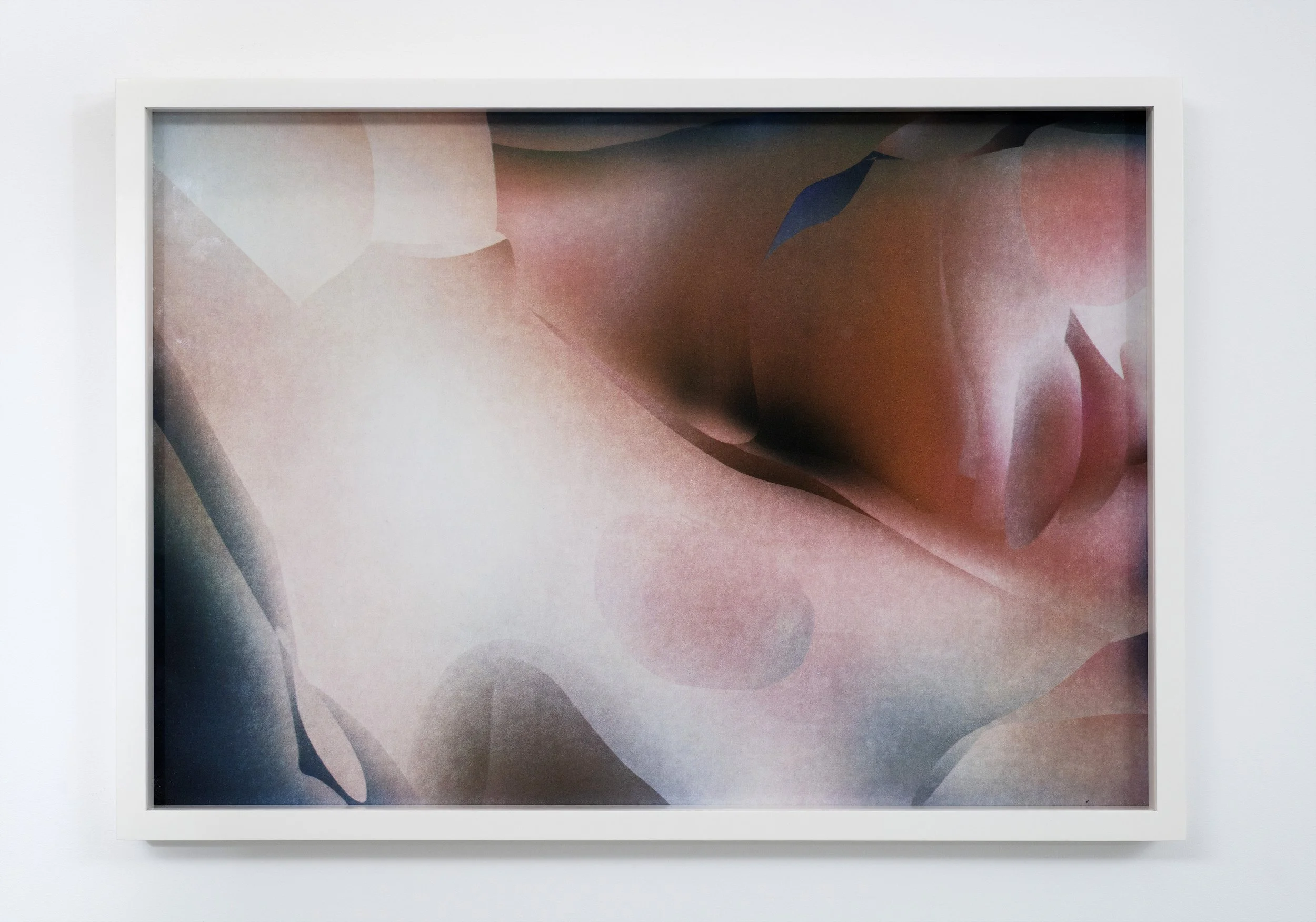
Angela Santana, Elation, 2022, Etching, Ink on paper, 17 × 24 in.