
148. DAICHI TAKAGI: A SPACE BETWEEN THE ONE WHO SEES AND WHAT IS SEEN.
PREVIEW
Daichi Takagi: Suchness, David Zwirner - LONDON.
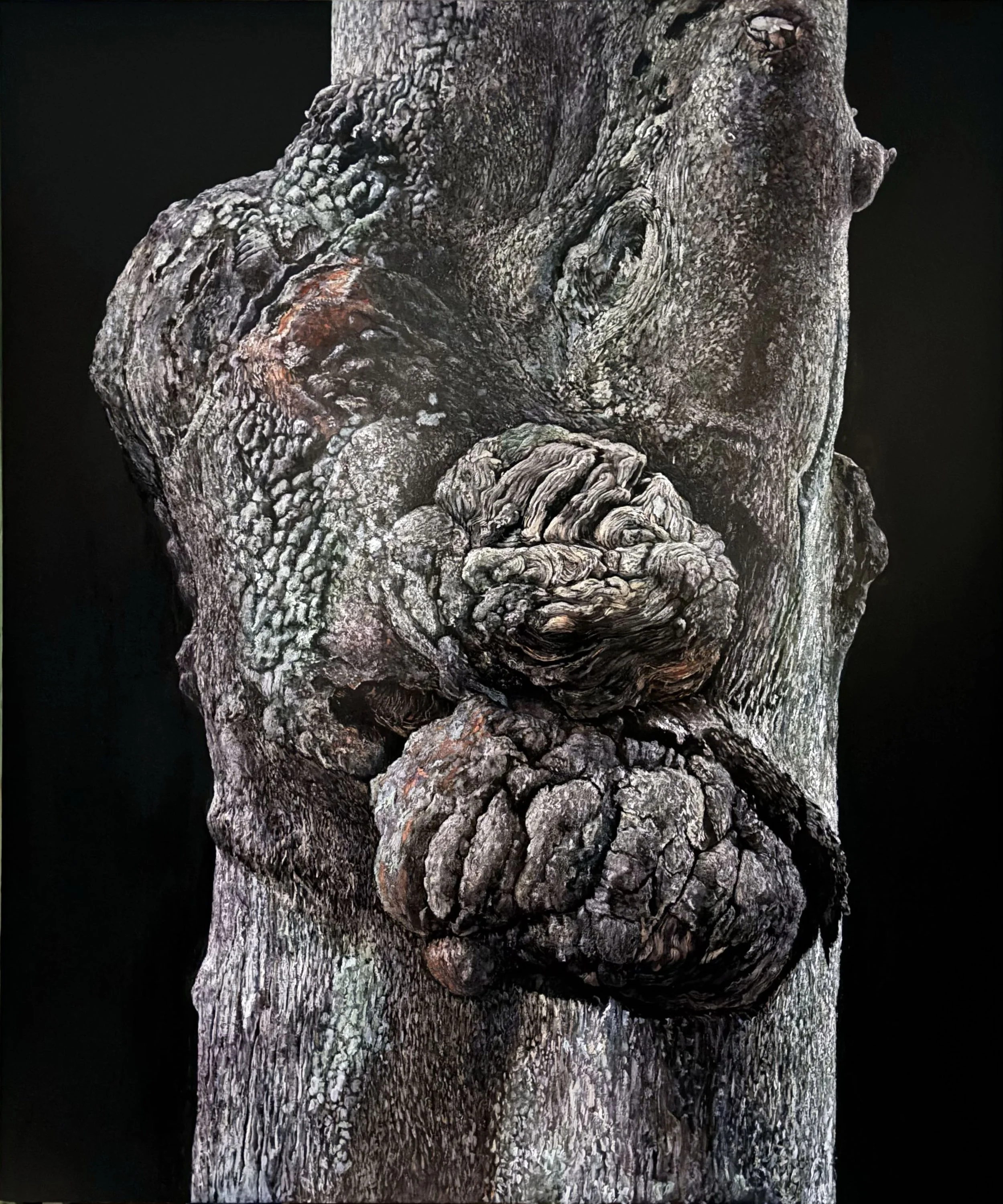
Daichi Takagi, Trunk,194 x 162cm, 2026, oil on canvas. © Daichi Takagi Courtesy Kayokoyuki, Japan and Ramiken Crucible, New York.
‘Where did we come from, and where are we going? How did the universe begin? The thoughts keep circling, and in my paintings, I want the viewer to feel as though they are wandering through questions that have no answers.’
Daichi Takagi
Please will you introduce your exhibition ‘Suchness'?
The title of the exhibition, Suchness, refers to a state in which things simply “are as they are,” or “exist just as they are.” In Buddhist terminology, it is translated as shinnyo (真如), which in that context refers to reality in its ultimate nature, beyond name and form.
My practice begins by stepping away from the tendency to fix an object as “this is what it is” before it has been conceptualized, and instead trying to see it as it is. I attempt to capture on the canvas the presence of the thing itself, the space that arises around it, and the experience of encountering it.
The use of sequences within the works that you have made in the past are fascinating; these proposals of puzzles which somehow resist being solved. Please will you discuss your impulse towards composition within your practice?
Whether it is culture, life, or the time that the universe itself holds, nothing remains in exactly the same state. Everything is constantly changing and in flux; it is only that, at this particular moment, things happen to exist in this particular state. There is something of the Buddhist ideas of kū (emptiness) and mujō (impermanence) in this.
No two stones or trees are ever exactly the same. Even a single stone can look different depending on its condition. A stone can begin to look like a planet; if you stare at it long enough, you can lose any sense of distance or scale, and sometimes an endless chain of thoughts and fantasies begins to unfold. Thoughts and experiences with no final destination. Everything is in circulation. I find that incredibly rich.
There is also a sense of time contained in repeatedly painting stones in my practice. There is the experience of looking at a stone on a micro scale, contrasted with taking in a vast landscape on a macro scale. Sometimes a person looking at it appears within the painting.
In this way, rather than fixing things into an orderly system, I try to bring different times, scales, perspectives, and experiences together across a single canvas, an exhibition, or a continuing body of work, in a way that does not settle on a single answer.
Where did we come from, and where are we going? How did the universe begin? The thoughts keep circling, and in my paintings, I want the viewer to feel as though they are wandering through questions that have no answers.
Depictions of a single light source are often prominent within the works: the moon, the lighthouse. What do these forms of light symbolise for you?
For me, light is less something that symbolizes a particular thing than a condition that allows things to appear, to become visible. At the same time, it is something that gives birth to darkness.
The light of the moon or a lighthouse does not illuminate everything. It illuminates only part of the darkness, while at the same time making us aware of what remains unseen. Covered by darkness, we cannot perceive all that is there, and yet we sense its presence. It is a light that gives rise to both what can be seen and what cannot.
There is a sense of the sacred within your practice, of the symbolism of humility, in the, at times raw brushstrokes, in the feeling of reduction in colour and composition, in the natural source material. Please will you contemplate the sacred within your practice?
I am conscious of incorporating the “sacred” into my practice.
There is a sense of something that cannot be seen, but nevertheless certainly exists. A great presence imbued with sacredness and the sublime. I want that to be felt through my work.
The awe toward nature, and the finding of sublimity in mountains, trees, and stones and making them objects of faith, exists not only in Japan but, with differences, across many cultures. There is also the Japanese expression yaoyorozu no kami, the “eight million gods,” which conveys a sense that this kind of spirituality resides in everything around us.
I grew up in a relatively devout Buddhist family. My family would recite Buddhist sutras every morning and evening, and during the summer I would sometimes stay at a temple for training. Looking back, I think I have always lived with some belief, somewhere within me, in a great presence that cannot be seen.
There are weathered Buddhist statues and Jizō figures by the roadside that have reached a state where you can no longer quite tell whether they are simply lumps of stone or statues. And yet they remain objects of faith. They are material things that exist in this world, while the passage of time and human thoughts have given them a special meaning.
I think my desire to express the vividness of that presence leads not to an expression that is overly centred on myself or self-indulgent, but to observation and direct engagement with the subject. I think this is reflected in my brushwork, my restrained colours, and my simple compositions. In particular, the expressions and lines found in natural things have an affinity with my brushwork, which is accompanied by a sense of physicality, and this is another reason why I find them appropriate motifs for my work: I want to retain those qualities.
Today, art is no longer simply made for the purpose of creating religious experiences; different cultures and contexts are intricately intertwined. But I feel that, on a more personal level, such qualities can still find expression through art, transformed into things such as the breath of an artist that can be felt in their brushwork, or the sensibility expressed through their use of colour. I think that a sense of personal faith or the sublime can still emerge through these things. I think that great works of art possess a certain sacredness, although it takes different forms, and that is something I want to express in my own work as well.
There is a palpable state of rest and acceptance within your paintings, which is felt before the title of the exhibition was known. If you could reflect back upon your practice as a whole, what do you feel the work tells you that you are doing?
Looking back over my practice as a whole, to put it simply, I think I have been trying to capture “pure experience” all along.
There is the idea of “pure experience” in the work of the modern Japanese philosopher Kitaro Nishida, as well as a sense of funi—non-duality—in Eastern thought, which does not regard the boundary between the self and the world as fixed. It is nothing particularly extraordinary, but rather a direct experience that exists before the distinction between subject and object, between the one who sees and what is seen. This is how I perceive things.
I want to capture that pure experience, that moment when sensibility is at work. In that moment, things exist before they are divided up through concepts or meanings, and one needs simply to be present in the moment itself. There is no need to understand or judge anything. Perhaps you could call it the state of “rest and acceptance” mentioned in your question.
The experience of being moved by a great work of art, or simply having your heart moved by looking at a landscape — these are moments when something fundamental in us comes into play. I want to retain that primordial sensibility.
Your works evoke a fascinating sense of being between conscious states, as to somehow return and yet discover simultaneously. As to witness a spring garden now covered in snow. Do you return to an internal space when you work, and if so, what does this space represent to you?
There are certainly landscapes that become visible when I dive deeply, deeply into, or return to, the space within myself. It is a space where sensations accumulate that make me think, “I had this kind of sensibility within me,” or, “This feeling really was there, wasn’t it? It was already something that existed within me.”
It does not refer only to my own memories or personal experiences. It is something more like a feeling that exists before it becomes language, before it has taken any clear form.
This overlaps a little with my answer to the previous question, but I think the sensation that exists just before we recognize something is important. I hope my work can give that kind of impression as well. I think my paintings are something like an opportunity to come into contact with that feeling.
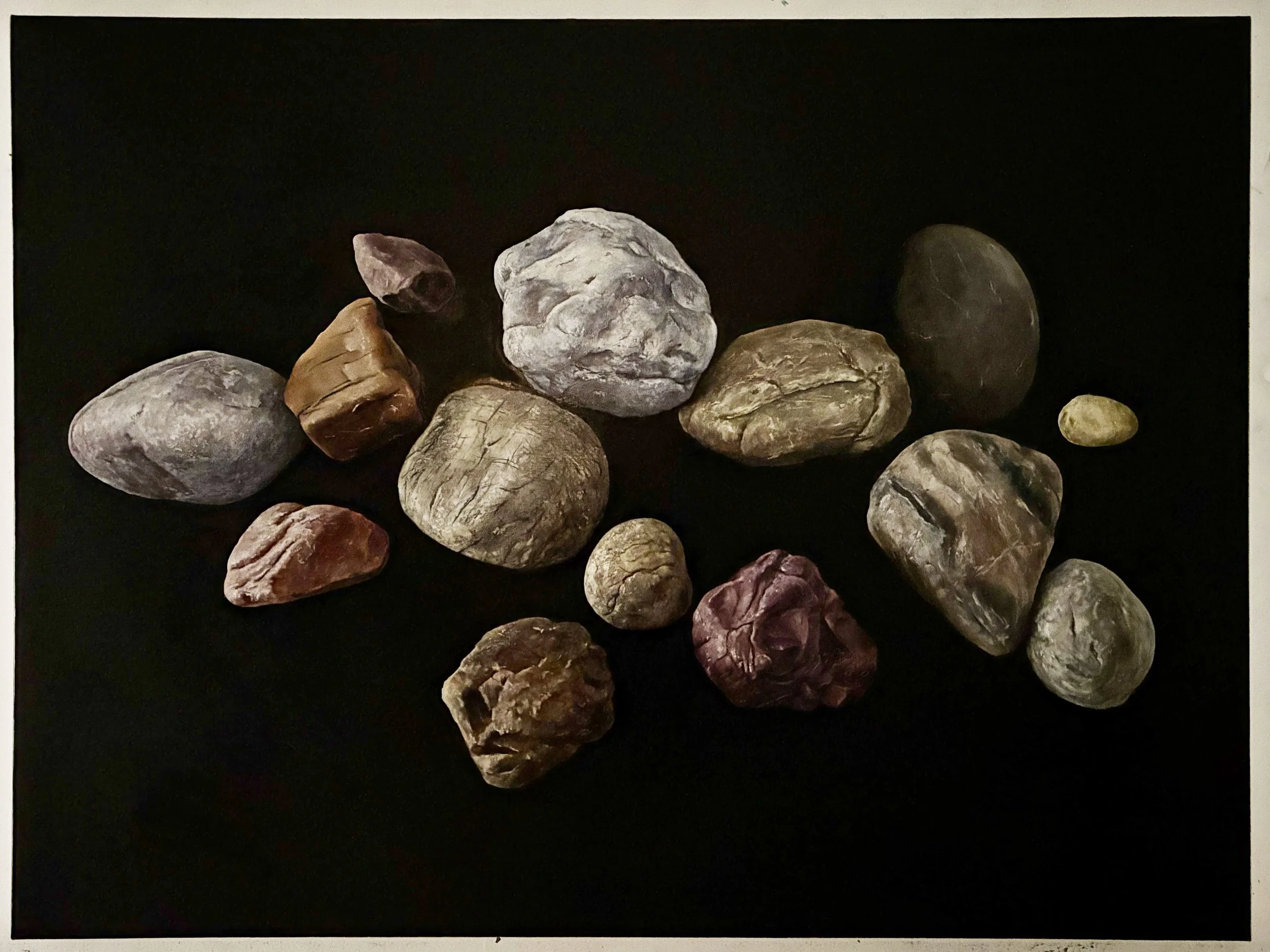
Daichi Takagi, Stones, 97x130.5cm, 2026, oil on canvas. Courtesy of the artist and David Zwirner.
Daichi Taichi: Suchness, David Zwirner, London. From 24 September until 31 October 2026.
Text Daichi Taichi and Joe Richards M-A (A SPACE BETWEEN) © 2026.
With special thanks to Sara Farquharson Chan and Ilaria Bevan at David Zwirner London.