
Kubolor’s Dream, Le Parlour - LONDON
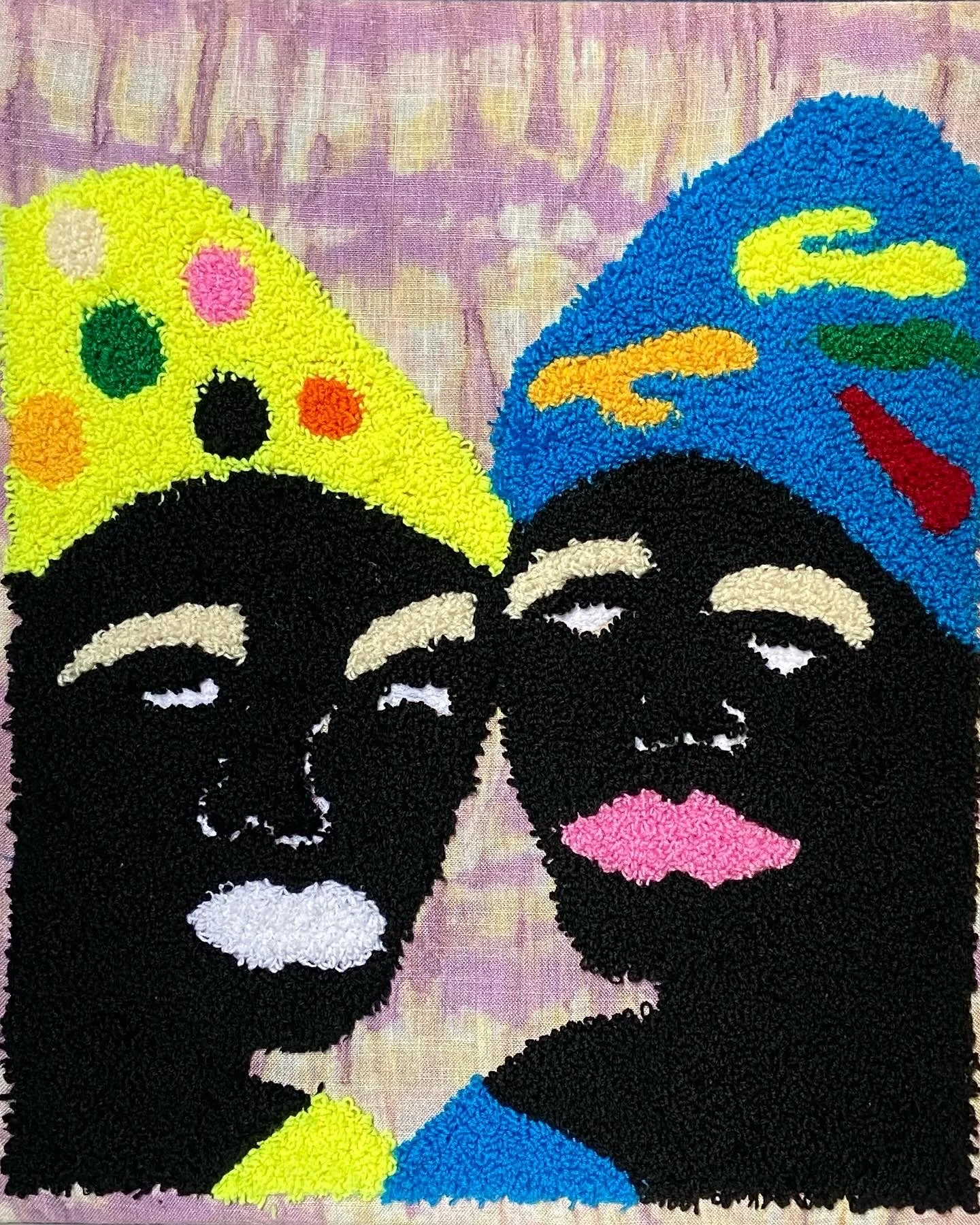
Ofe Amponsah, Shadows of Bias, 2024. Mixed Media (hand tuffted yarn on tie dye upcycled cloth) Framed 77 X 70cm. Image courtesy Ofe Amponsah ©
‘For me, making the work is not always about having all the answers. It’s about working through those questions and allowing them to take shape through the materials. In Kubolor’s Dream, a lot of that comes back to identity, freedom and the tension between who society expects us to be and who we want to become. In a way, the time I spend making each piece also becomes time I spend understanding myself.’ OFE AMPONSAH
Please, will you introduce 'Kubolor's Dream', currently on show at Le Parlour, London?
KUBOLOR’ DREAM Within Ghanaian parlance, kubolor is a Ga term commonly used to describe a truant, wanderer, or vagabond. Historically, the word has carried negative social connotations, often referring to individuals perceived as aimless, unruly, or existing outside accepted social norms. Over time, however, the meaning of kubolor has evolved beyond this stereotype. The term has come to embody qualities such as improvisation, curiosity, adaptability, and an ability to navigate uncertainty with ingenuity. Rather than simply signifying social deviance, the kubolor can be understood as a figure who moves fluidly through the city, learning from its rhythms, encounters, and possibilities. For many Ghanaians, the kubolor is a familiar social character. Growing up, the term was often associated with people from lower socio-economic backgrounds, and much of its stigma emerged from these class-based perceptions.
Depending on the context, kubolor could function either as an insult or as a term of affection, reflecting a complex relationship between marginality and admiration. The kubolor occupies a position at the edge of social respectability, yet is often celebrated for resilience, resourcefulness, and an unconventional sense of freedom. This figure bears certain similarities to the nineteenth-century flâneur, popularized by Charles Baudelaire as a keen observer of urban life.
Both the kubolor and the flâneur derive knowledge from wandering the city and engaging with its social and spatial rhythms. However, they differ significantly in terms of class and circumstance. The flâneur emerged from the bourgeois society of nineteenth-century Paris, where leisure and economic privilege enabled him to wander as a detached observer. The kubolor, by contrast, is rooted in the social margins of the contemporary Ghanaian city, where movement is often shaped by necessity, improvisation, and survival.
While the flâneur observes the city from a position of privilege, the kubolor experiences it from within, navigating its uncertainties and informal networks. In this sense, the kubolor represents a more immersed and contingent form of urban knowledge, shaped not by leisure but by lived experience.
I, similarly adopt Kubolor as a moniker, embracing its layered histories, social connotations, and evolving meanings. For me, being a kubolor is not simply an identity but a way of moving through the world, one driven by curiosity, exploration, and experimentation. This disposition has become central to my artistic practice, shaping the stories l tell, the materials I work with.
The sense of time and the processing of it really intrigued me when seeing the works. The notion of working with a medium which is slow and not necessarily measured in digital ticking but bodily heartbeats feels important, as the works are nuanced in humanity and, because of this, are highly emotive. When you are working within a piece, may I ask, what are you processing?
I think a lot of what I process in my work comes from my own experiences and the things I find myself questioning about life. Growing up, I had a certain idea of how success was presented to me and how it is supposed to look, and for a long time, I felt the pressure to follow that path. As I got older, I started questioning those expectations and trying to understand what it means to live on my own terms.
Working with textiles gives me the time and space to sit with those thoughts. The process is slow, and I think that slowness is important because not everything we experience can be understood immediately. Sometimes, you need time to reflect, to question things and to see them differently.
For me, making the work is not always about having all the answers. It’s about working through those questions and allowing them to take shape through the materials. In Kubolor’s Dream, a lot of that comes back to identity, freedom and the tension between who society expects us to be and who we want to become. In a way, the time I spend making each piece also becomes time I spend understanding myself.
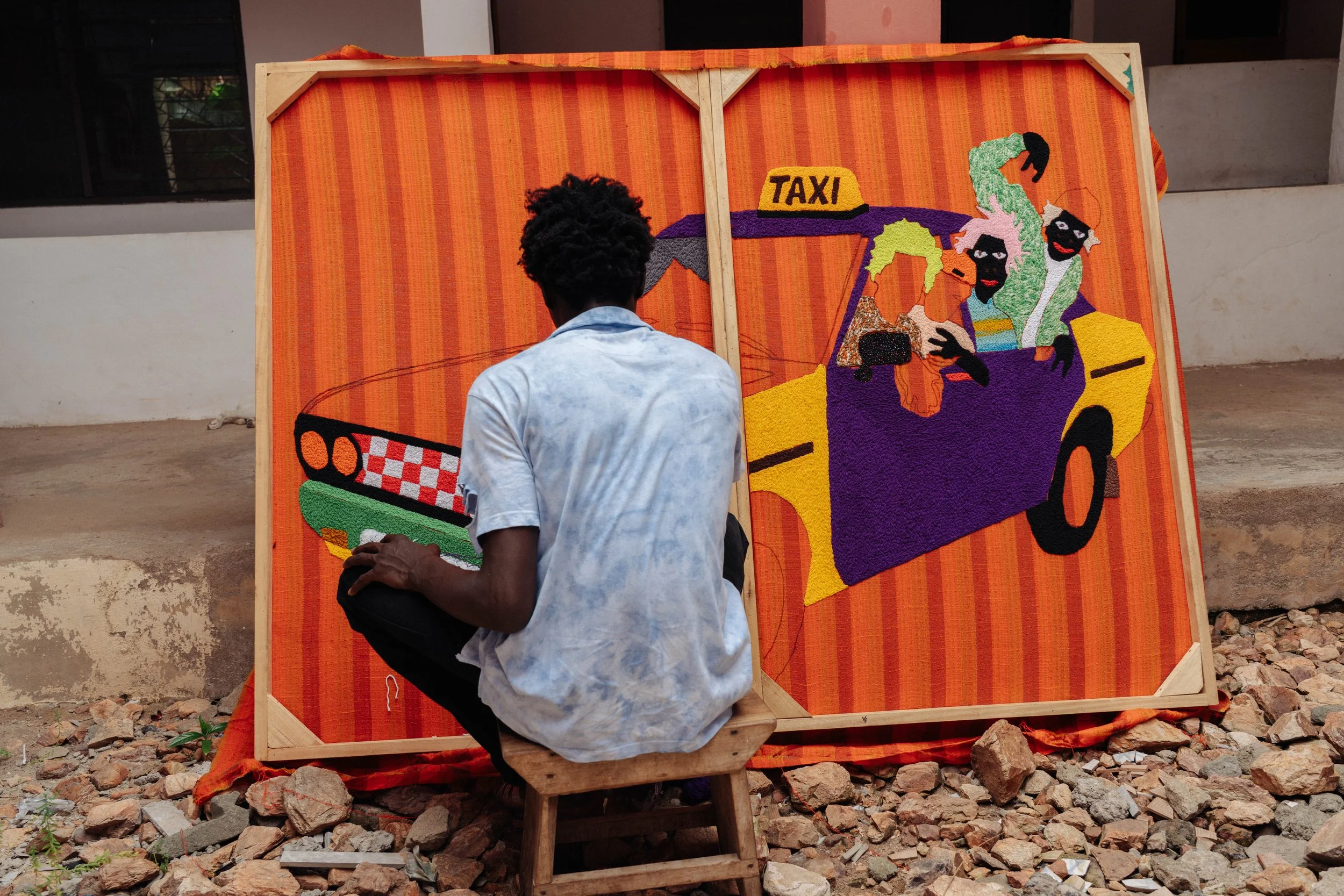
Ofe Amponsah
The relationship and dialogue between generations within the works are fascinating, especially within the use of visual metaphor. Please will you contemplate this within your practice?
I think the relationship between generations is interesting because, often, the dreams we pursue are shaped by the people who came before us. In ‘Free To Be Free To Dream’, I explore the tension that can exist between older and younger generations, when it comes to the pursuit of success.
Sometimes, the younger generation wants the freedom to explore a different path, to take risks and discover what success means to them personally. But for the older generation, that uncertainty can be frightening. They may have a particular idea of what a secure and successful life should look like, and seeing their children move away from that path can create fear and concern.
I don’t think that fear always comes from a place of control. Sometimes, it comes from protection. The older generation wants to protect the younger one from uncertainty, disappointment and the difficulties they may encounter. But in trying to protect us, they may sometimes struggle to give us the freedom to discover our own way.
Through this piece, I’m interested in that space between protection and freedom, between the dreams we’re taught to pursue and the dreams we eventually choose for ourselves. I think it’s a conversation between generations, where both sides may want the same thing, a better life, but have different ideas about what that life should look like.
The nature of the tufting is intriguing, especially so within your work and this presentation, where a house is symbolically fashioned from repurposed shirts. The tufted textile process and medium, within a domestic space, traditionally would be a furnishing fabric, a textile which bears silent witness to the lives lived. This point of bearing witness, what do you feel your works as a whole communicate?
The house is a collection designed by Harris Elliott, inspired by his childhood memories, his aunts’ home, and the shirts that were handmade for him growing up. I think what makes this collaboration interesting is how the house brings together his personal memories and my own exploration of identity, freedom and belonging through textiles.
My work is drawn largely from personal experiences and my own journey of trying to understand what freedom, identity and individuality really mean to me. I’m still navigating these questions myself, and I think that uncertainty is part of why I sometimes struggle to fully accept the label of being an artist. I’m still discovering what that identity means to me, rather than feeling that I have to fit into a particular definition of what an artist should be.
I think my work communicates that journey, but I don’t necessarily want people to see themselves through my lens or experience my stories exactly as I do. We all come from different backgrounds and perspectives, so I’m more interested in allowing people to approach the work through their own experiences and interpretations.
If my personal journey can encourage someone else to question the expectations placed on them, explore their own identity, or find their own understanding of freedom, then I think the work has achieved something meaningful. For me, the works are a way of processing these questions, but they don’t necessarily provide fixed answers. I’m still asking these questions myself, and I think there is something beautiful about creating work that allows other people to ask them too.
Aside from the works that you make, what is your relationship with cloth? Do you have garments, textiles that you rely upon and favour in your life?
I think cloth has played an essential role in our lives for generations. Beyond my work as an artist, I see clothing and textiles as a form of expression, a way of communicating who we are, our status, our culture, and how we want to be perceived by others.
My background in fashion modelling has also shaped my relationship with clothing. I’ve always been interested in fashion and how what we wear can reflect our personality and individuality. For me, it’s not just about following trends, but about finding pieces that express my identity and allow me to present myself in my own way.
I think what fascinates me about cloth is that it can communicate so much without us having to say anything. It can tell stories about where we come from, what we value, and how we want to be seen. That’s something I carry into my art, but it’s also something I appreciate in my everyday life.
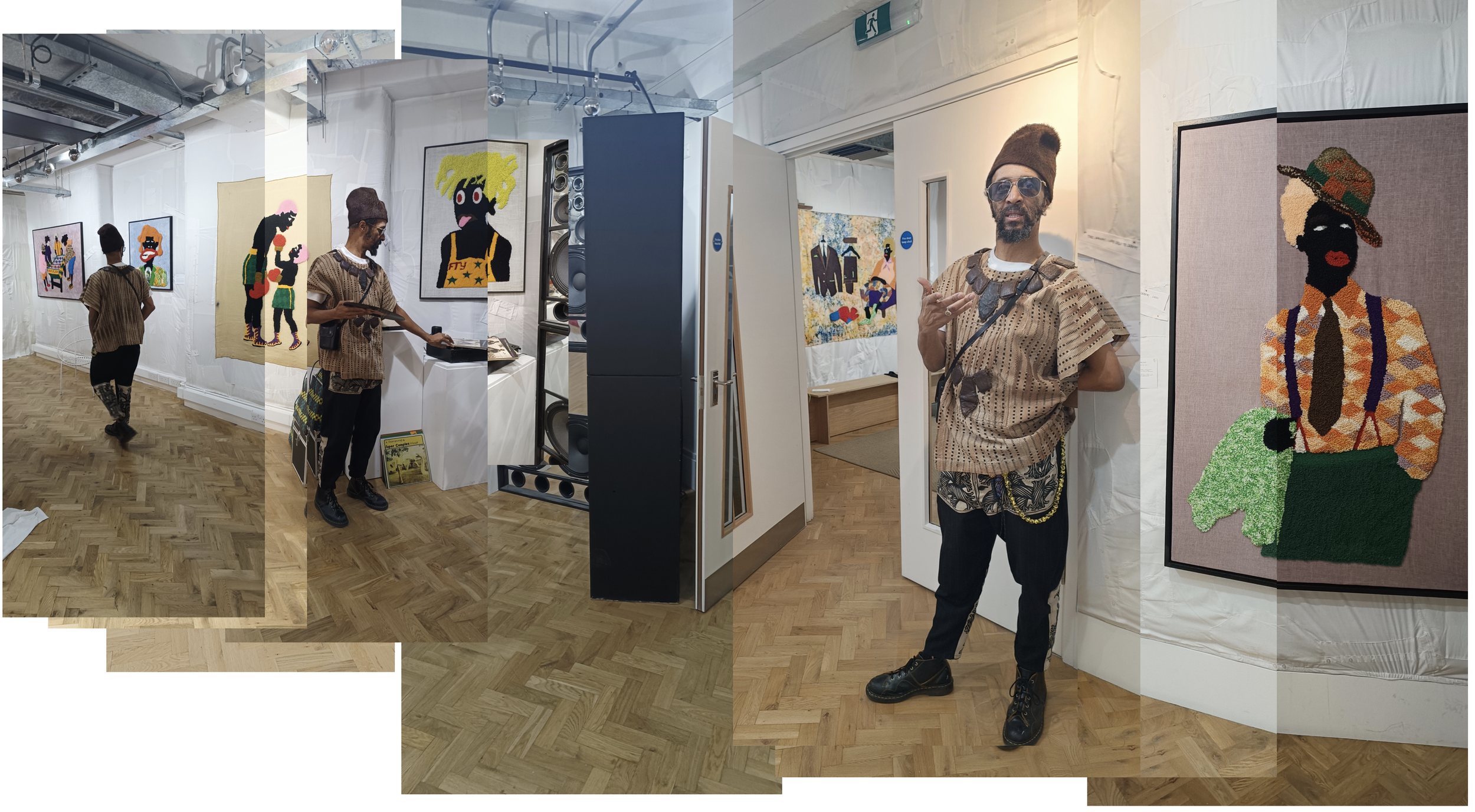
Harris Elliott walks through exhibition: Ofe Amponsah ‘Kubolor’s Dream’, Le Parlour by Harris Elliott. The Casbah, 20 Little Portland Street, London W1W 8BS. Panorama collage: M-A (A SPACE BETWEEN) 2026.
OFE AMPONSAH, ‘Kubolor’s Dream’ Le Parlour - The Casbah, 20 Little Portland Street - London.
With thanks to Harris Elliott.