
131. PAUL MPAGI SEPUYA: A SPACE BETWEEN WITHIN AND APART.
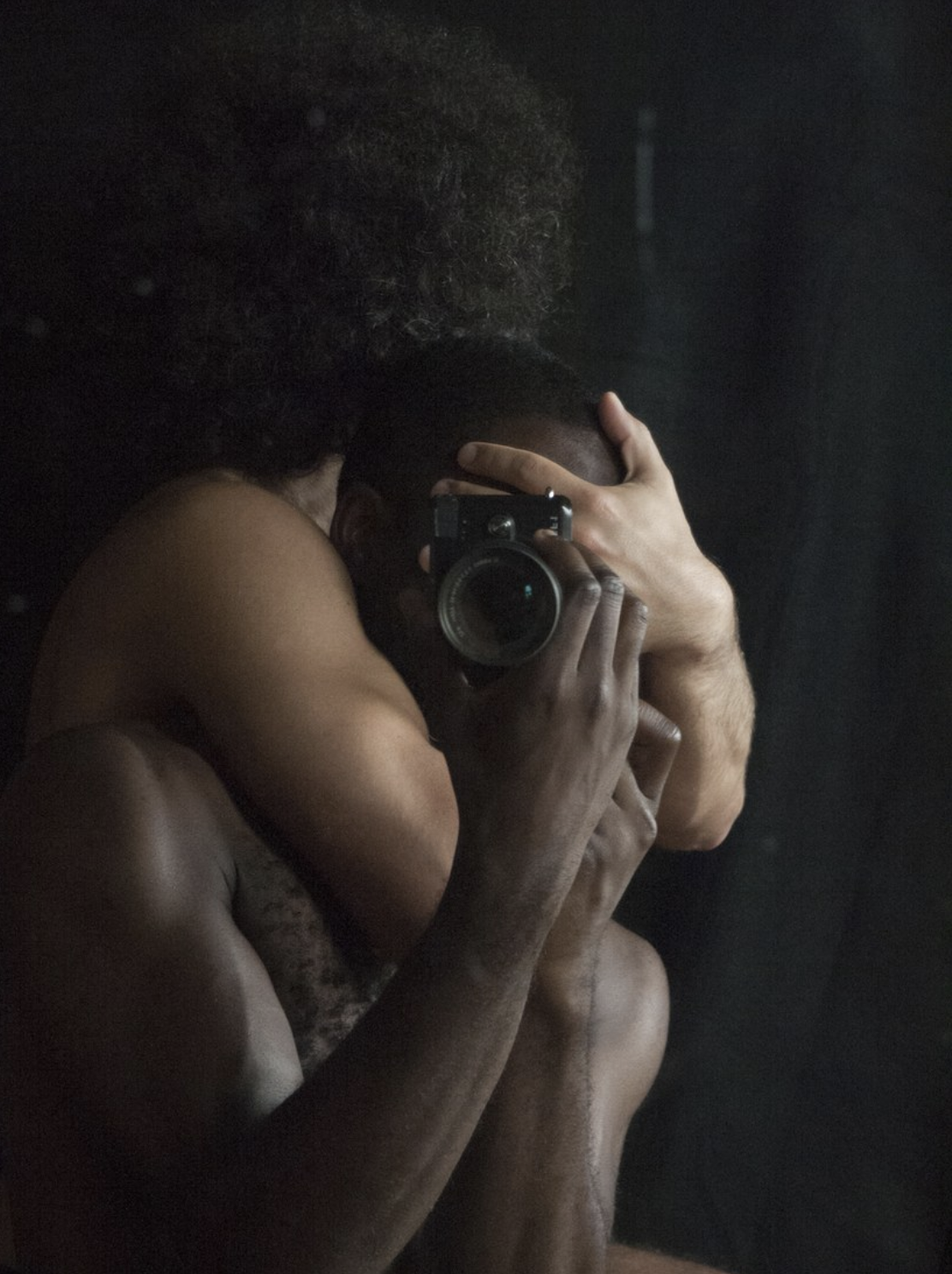
Paul Mpagi Sepuya, Darkroom Mirror (_2070386), 2017, 24 x 32 inches. Courtesy of the artist, © Paul Mpagi Sepuya.
‘…the mirror is overall a device that creates a boundary between subjects or objects and viewer. They draw the line at what is within, and what is apart. What I like about this is what’s left is desire as a method of navigating this boundary.’
Paul Mpagi Sepuya.
To see a work by Paul Mpagi Sepuya is to enter an atmosphere which appears conscious of our gaze.
Billboard in scale, his life-sized figures, often staged within swaths of curtains, evoke a protective set - a space of improvisation, careful to record the pivotal in the play.
As to be conscious of a position held by others and to embody a tender curiosity which exists on the very edge of instinct.
Seeing your work at Paris Photo was revelatory. A monumental image: two figures gently holding each other, the asymmetry of composition, the sense of a stage within a space which seemed poised and yet ambiguous. And the scale - as a 17th century European oil painting...
It was extraordinary to witness within the Grand Palais, a space filled with activity and noise, and when I saw your work: Sudden silence.
Thank you, it’s always nice to hear how people encounter my work for the first time.
Twenty years into this, and about a decade into the work that really came to be known to wider audiences, it’s helpful and good to know how what to me feels so familiar does appear to new eyes. The title of that work is Daylight Studio (0X5A4577), from 2022. It’s from a series from Spring 2021 through roughly Fall 2023 called Daylight Studio / Dark Room Studio, which was a follow-up to my 2016 - 2021 project Dark Room, that explored play and intimacy within formal construction and deconstruction of my studio and the space of the photographs through mirrors and other elements. This new series was sparked by moving studio spaces, and in the process of settling in, looking at historic images of Western European and American photography studios.
I began noting at first, and gathering objects - antiques, postmodern and contemporary pieces - to inhabit a kind of historic but resonant space. I began photographing myself alternating between working or preparing the space and resting, or napping, and then as COVID opened up, inviting friends in. This is a rare photograph made with someone I met that same day. Vonnie asked what I did, I explained this project and he asked to come by and take part. I’ve mostly resisted photographing at-the-time stranger for many reasons, but these pictures really came out thanks to his curiosity and our playfulness.
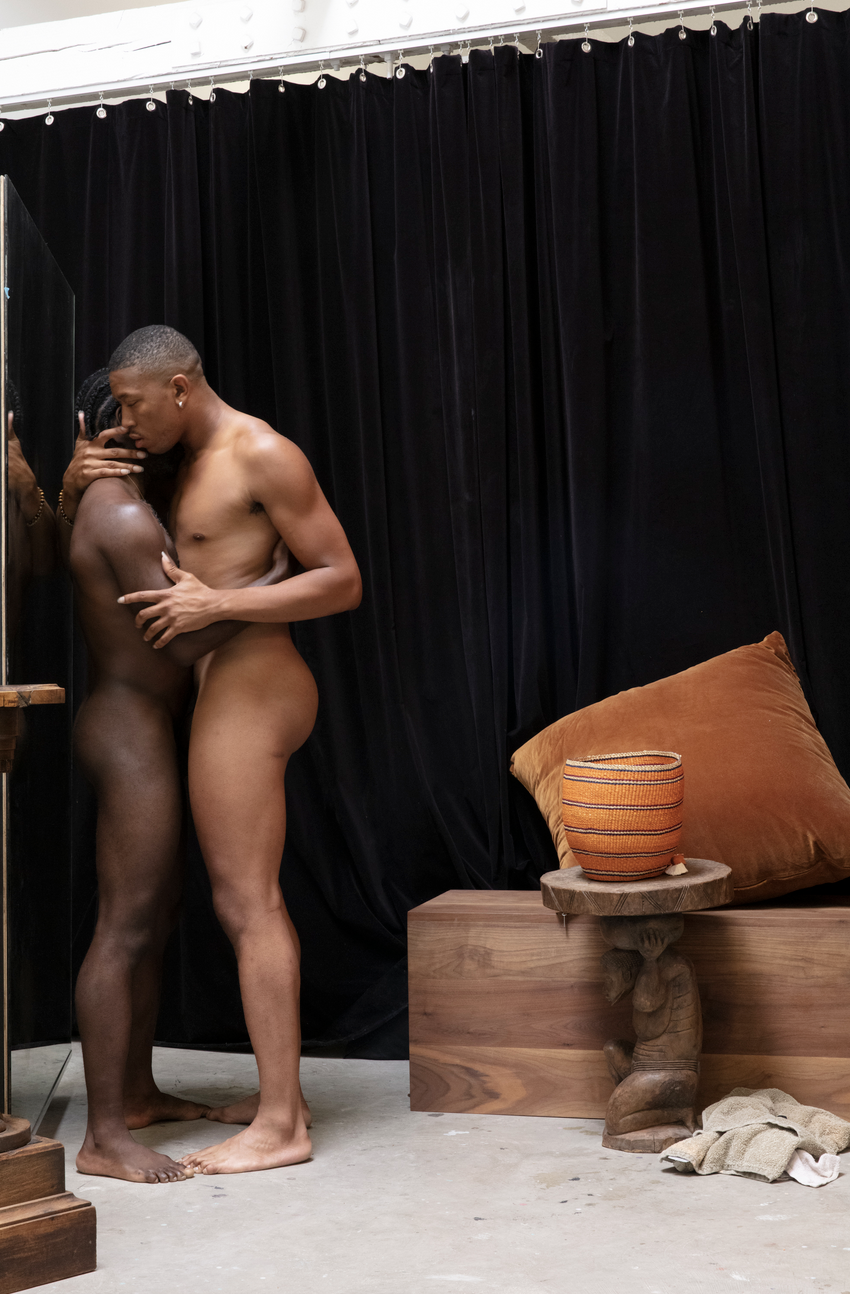
Paul Mpagi Sepuya, Daylight Studio (0X5A4577), 2022, 50 x 75 inches. Courtesy of the artist, © Paul Mpagi Sepuya.
The veiled spaces are really fascinating…
Maybe I’d describe them as nested spaces within the photographs that contain something being looked at, or reflecting what the viewer of the final image cannot see. Every backdrop divides a space into what’s between the material and the wall, and then what’s behind it. I was just curious about that space. But there are very few veiled spaces, except maybe in the “SCREENS” works. There are backdrops that serve as dividers, there are mirrors at angles. There is the camera that obscures a subject’s face with its own reflection.
Observing the images, I was fascinated by the sense of a surface as witness - the occasional smudged fingerprints, the torn tapes - fragments of the temporal... All form a sense of being held and a sense of touch, the focus on hands but spaces which seem to hold time... Will you expand upon how you use space and ideas of space within your practice?
Yes, surfaces have been a major formal and conceptual aspect of the larger DARK ROOM project and the project that followed in Daylight Studio / Dark Room Studio. In many of the pictures, what you are looking at is a photograph made of the surface of a mirror, which includes reflected the camera making the picture. The photographs shown at Paris Photo Voices are all “direct” pictures as in they are not of reflections, but in each, there is a mirror present that provides to the figures their reflection to engage with. What I’m interested in with these is that there is a closed loop, a circuit happening between the subject(s) and their images, that is not visible to the viewer of the final photograph. A hidden intimacy there.
The returning use of reflections feels more of a gesture within your work than a direct object, even when mirrors are utilised. This really interested me, how through movement and observation, you explore a sense of return. A feeling as a echo, which at times feels like a time delay... Please will you contemplate the use of a mirror within your practice?
The use of mirrors began in 2014 with initial studies, a series of photographs and using them as surfaces on which to affix unresolved image material and notations. Creating formal arrangements that would only come together and be photographed through the point perspective of the camera placed on a tripod in front of and facing the mirror. I realized that its surface should not disappear so that its presence could be noticed. It was not meant to create a trick. So I stopped cleaning the surface between photographs and smudges developed. The DARK ROOM project began when I was experimenting with new portraits while using backdrops in my space, and it caught my eye that when reflecting these black and brown fabrics, the otherwise latent smudges and fingerprints came into clear view. This opened up so many metaphors and ways of thinking. But the mirror is overall a device that creates a boundary between subjects or objects and viewer. They draw the line at what is within, and what is apart. What I like about this is what’s left is desire as a method of navigating this boundary. A desire to be in relation, or within, when realizing the space into which the viewer is looking is actually closed off, despite the camera’s reflection seeming to implicate them.
Your work evokes an ongoing exploration with collage and collaged conditions, which enable such an idiosyncratic state of poise. Similarly to an earlier thought about gesture, how do you know when you have reached a point where the work evidences how you feel?
That’s an interesting question, I’m not quite sure what you mean. The original “Studies” from 2014 - 2016 were temporary compositions for the purpose of making photographs that in turn looked like collages. Each was a response to the idea of a portrait of a person or persons close to me. So within them there is a kind of longing, missing, or wanting and desire. In the “DARK ROOM” series Mirror Studies that also were described as collage-like, they work for me in the same way. Later *actual* collages that I began making in 2018 were more about looking at composition. But all works for me have some nested sentimentality. But it’s a funny question because I realize I’ve never considered an evaluation of the work based on wanting the viewer to feel emotionally. Or about communicating anything about that on my end. What I want the viewer to feel is themself in relation to pictures and material that they are outside of, excluded from formally, but implicated in relation by way of their own desire.
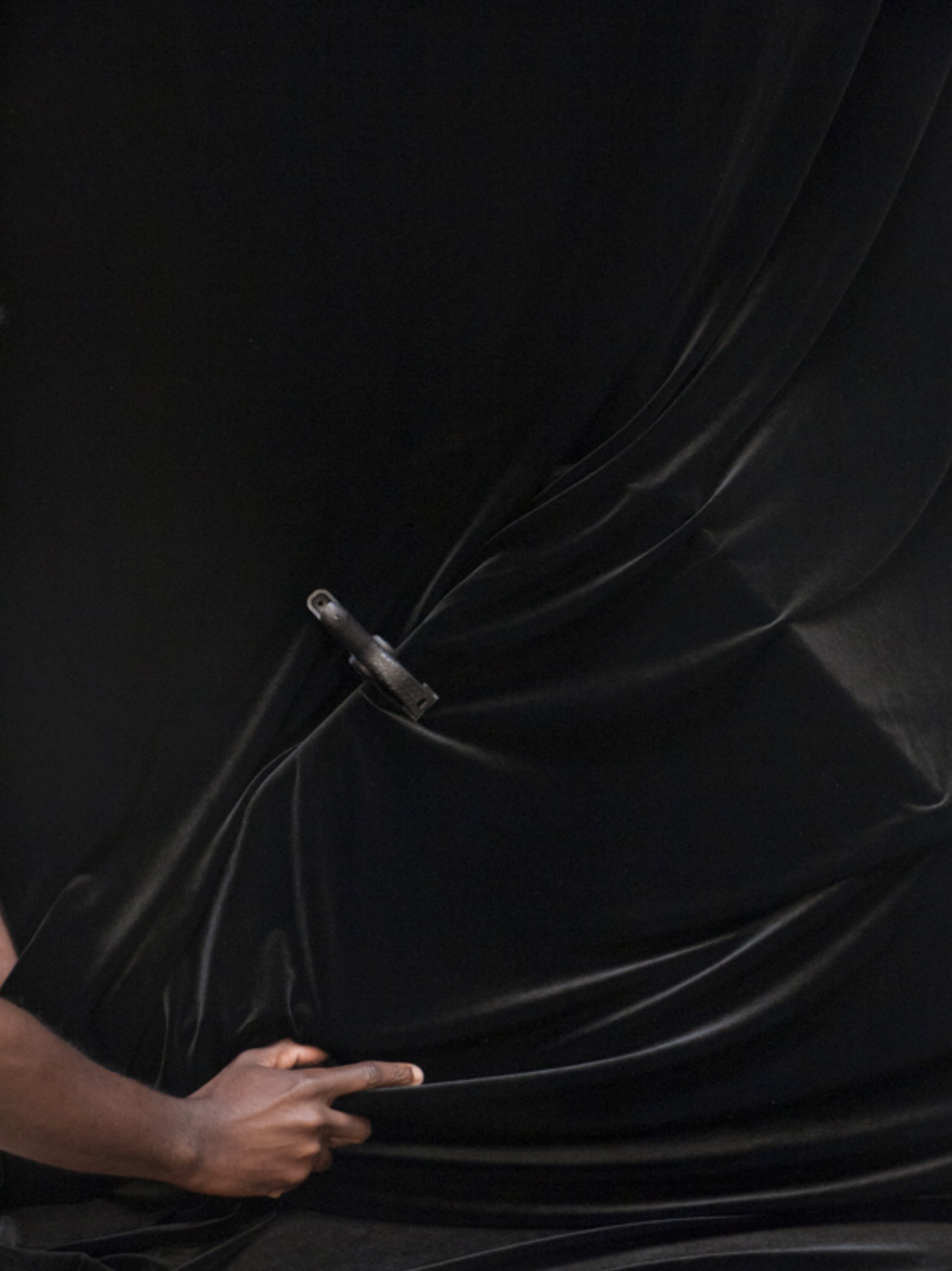
Paul Mpagi Sepuya, DARKCLOTH (_2000142), 2016, 24 X 32 inches. Courtesy of the artist, © Paul Mpagi Sepuya.