
Robert Ryman: The Real Thing,
Barbican Art Gallery - LONDON.
Interview with curator Wells Fray-Smith.

Robert Ryman, Surface Veil II, ca. 1970. Solomon R. Guggenheim Museum, New York; Panza Collection, 1991; 91.3840. © 2026 Robert Ryman / DACS, London. Photo: David Heald.
‘White enables Ryman to make painting itself visible. When you see a painting in white, it offers up texture, stroke, edge, line. He wasn’t interested in white as a colour – white is not the content of the work – but was interested in what it reveals to our vision.’ Wells Fray-Smith
The experience of seeing Robert Ryman's works in the real is very intimate, very different from on a screen - they somehow resist digitising. They resist in a very peaceful way. What do you feel are the recurring emotions which the artist explores within the works in the exhibition selection?
Ryman prioritised the direct experience of being with works physically, knowing that the meaning of his painting was in the experience we have with it. His project was to make painting visible, to show paint as paint, surface as surface, light as light. In doing so, he hoped that the experience of being with his paintings would be pleasurable, eliciting ‘well-being, rightness and delight.’ While Ryman didn’t pour emotions into his work, his paintings have elicited powerful emotional responses in viewers.
Of all the colours which the artist favoured, white reappears again and again, and yet his appreciation and application is varied, at times fluttering as petals, others dense as fog, and yet his use of white always seems to be alive somehow. What do you feel white represents within the artist's work?
White enables Ryman to make painting itself visible. When you see a painting in white, it offers up texture, stroke, edge, line. He wasn’t interested in white as a colour – white is not the content of the work – but was interested in what it reveals to our vision.
I first saw a series of drawings by Robert Ryman at the David Zwirner space in London. They included a series of grids, which I later realised were an ongoing interest to the artist. What do you feel are the main differences between works made as drawings and works made as paintings?
Ryman dedicated his career to questioning and expanding the definition of painting. He took some basic assumptions of the medium – that it involves paint, on a surface, set in relationship to the wall – and played with them endlessly, revealing that the possibilities for painting are endless. Throughout his career, he also made a number of drawings. While painting had an open definition, Ryman defined drawing by line. No matter what surface or if it involves paint or not, if a work by Ryman has a drawn line, it is a drawing. In paintings, a ‘line’ only emerges as an edge between strokes or as an edge between the stroke and the surface.
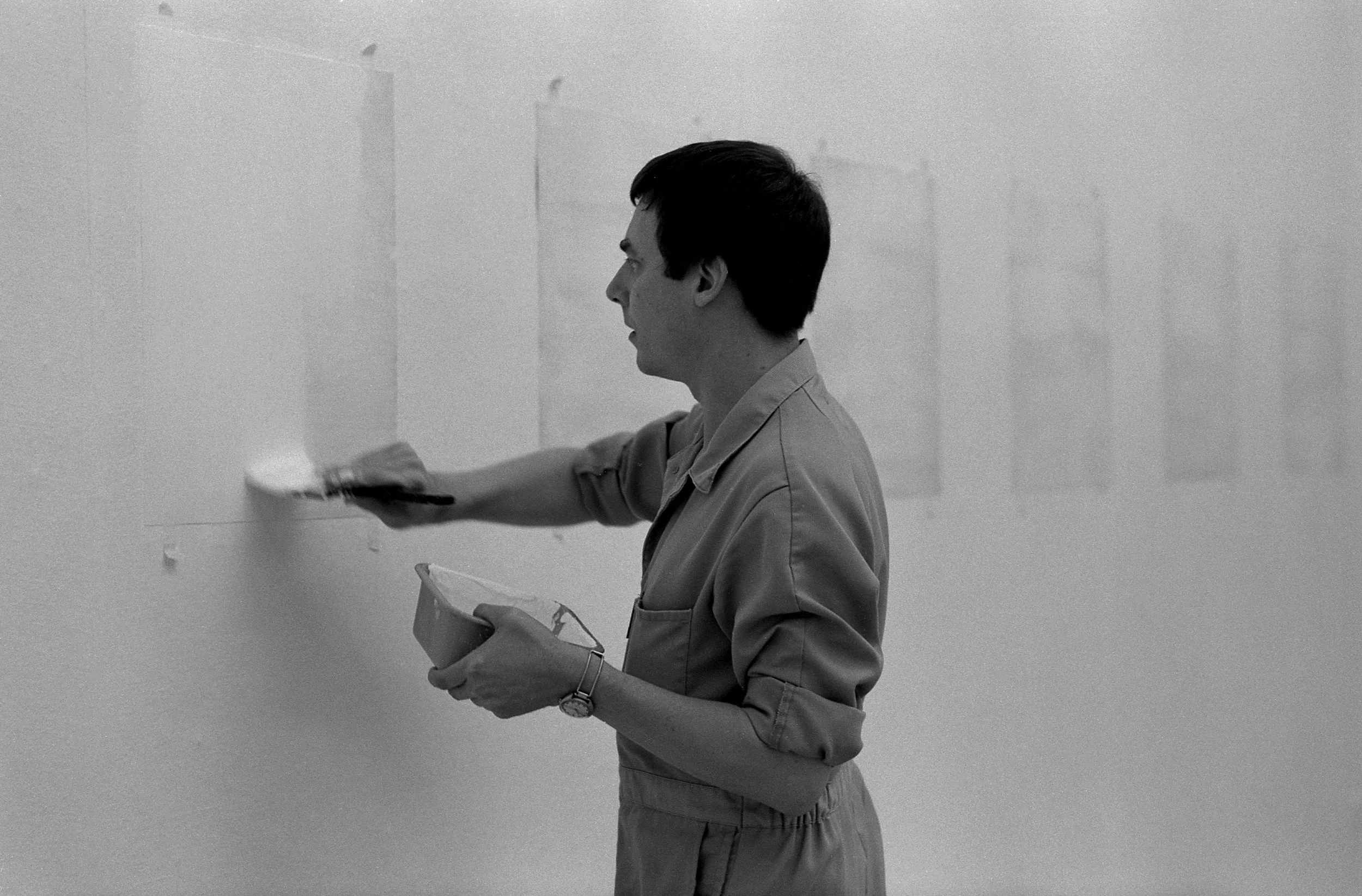
Robert Ryman painting at the Palais des Beaux Arts, Brussels, 1974. Photo Philippe De Gobert (c) 2026 DACS.
The surfaces of a Robert Ryman work are very particular - his use of specific materials creates idiosyncrasies; for example, the use of aluminium and polyester cloth, canvases and plexiglas creates works which often feel more like pools than flat spaces. A surface to another space, an entrance - what do you feel these spaces represented to the artist?
Ryman welcomed all interpretations of his work and what people noticed, but he never commented specifically. He was interested in materials and their effects, rather than any symbolism, myth or story suggested beyond the material. When he worked with new materials, he often didn’t know what the effects would be – he took a leap into the unknown and let the painting and its unique qualities reveal themselves to Ryman’s consciousness as he worked. He liked different materials for different reasons; fibreglass and steel he liked for their thinness, coffee filter paper he liked because the circle was an even and equal shape.
Ryman's connection to art history is fascinating; the way he referenced different periods within his own deconstructed manner is intriguing. As a musician may explore references to others within a piece of work, please will you contemplate Ryman's references to other artists.
Ryman began his career as a guard at the Museum of Modern Art, where he came to see and appreciate a host of artists he admired. He particularly liked Matisse, Cézanne and Rothko, noticing the ‘sureness’ of their marks, the directness of their paintings, or in the case of Rothko, how he treated painting as an object. Suzanne Hudson has done incredible research on Ryman’s time at MoMA, particularly the education department run by Victor D’Amico, who taught students to ‘not copy anything, not even nature.’ Ryman learned to paint by looking, but really learned to paint by doing it for himself.
The artist's personal history is very human in the sense that he explored many vocations before focusing his time fully on the medium for which he is well known. I think this inspires many who know of his life story to feel the joy and optimism in the works as a whole. What do you feel the artist's lasting legacy is?
The gift of Ryman’s work is that it asks us to pay attention. Art historically speaking, he cracked open how we might think of and define a painting, exploring its relationship to the wall, the hanging mechanisms, how it relates to light and space. With great material innovation, he also showed that committing to a relatively limited set of parameters can lead to an astonishing – and surprising – variety of results. More generally, the work offers an opportunity to really look. In doing so, I think there’s the possibility to notice things as they really are. As he makes paint in painting visible, tuning us into what is empirically presented to our consciousness, the world – as it really is – also begins to become more alive in our awareness.
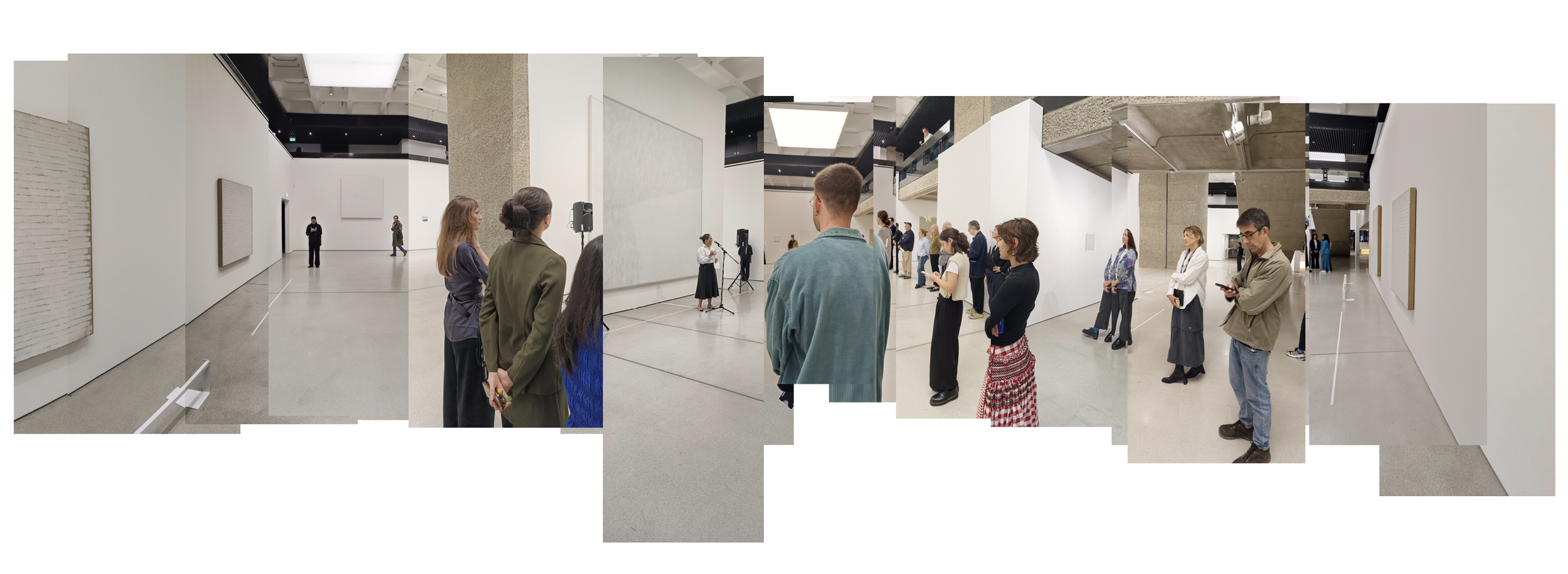
Panorama collage of Robert Ryman: The Real Thing, Barbican center London, 7th Oct, 2026, 11:34 AM. Image: M-A (A SPACE BETWEEN)
Robert Ryman: The Real Thing, Barbican Art Gallery. Until 28 February 2027
With special thanks to Rebecca Lally.